
The Thought of Henryk Grossman: A Review Article

The publication in 2022 of The End of Capitalism: The Thought of Henryk Grossman by Ted Reese, published by Zero Books, marks a renewed interest in the breakdown of the capitalist system and the forces driving capitalism towards this breakdown. Obviously, this new interest has been generated by the problems of capitalism over the last two decades such as the sub-prime crisis, the economic collapse associated with Covid-19 and central banks imposing negative interest rates and negative rates for government bonds. This is the first time in the history of capitalism that negative rates for central bank loans and government bonds have been applied. Grossman’s most famous book The Law of Accumulation and Breakdown of the Capitalist System, is directly relevant to the mass of problems now facing the system. This book, published in 1929 shortly before the Wall Street collapse, argued that the capitalist system had an inherent tendency to systemic breakdown and located the driving force behind the breakdown in the tendency of the rate of profit to fall, something which has become empirically evident and which some economists now admit. All this has led to a renewed interest in Grossman’s work. The book by Reese has been helped by an Australian Marxist, Rick Kuhn(1), who has published a biography of Grossman and his collected works including a complete edition of The Law of Accumulation. The previous edition, published by Pluto Press in 1992, is apparently incomplete. Kuhn’s publication also includes articles and texts Grossman wrote in the 1930s and 40s and letters, some of which are to Paul Mattick who did more than anyone else to publicise Grossman’s work. The Law of Accumulation, despite coinciding with the acute capitalist crisis following the 1929 collapse, was published to almost universal condemnation. This is explained by the fact that the dominant theories of crisis, at that time, were those of disproportionality and underconsumption. Grossman was accused of arguing capitalist breakdown was mechanical and ignoring class struggle. Reese’s book tries to refute this criticism.
The book includes interesting accounts of Grossman’s early life and political activity in Galicia, Austrian Poland, his move to Vienna in 1908 to pursue an economic career, his mobilisation into the Austro-Hungarian army during the First World War, his recruitment as an economic advisor to Count Czernin(2) and other new details of his life. After the First World War, he moved back to Poland but was imprisoned and subsequently exiled to Germany in 1925. Following the Nazi rise to power in 1933 his life was one of exile, first in Paris then Britain then the US and finally East Germany. Grossman had by then completely rescinded the critical political views he developed during the early 1930s, joined the ruling Socialist Unity Party and defended the USSR as socialist; socialism for him being the lower stage of communism. He also supported Comintern policies such as the united front and national liberation. These are positions which Reese shares which makes a lot of the comments in Reese’s book, which clearly support these positions, difficult to stomach from a Communist Left perspective. The book ends with a section identifying the contemporary developments which Reese considers are the signs of the coming breakdown. Reese argues that some of these represent socialist measures growing in the womb of capitalism in a parallel way to the development of capitalism within the womb of feudalism which we will consider below. The book is, however, a sound economic explanation of Grossman’s economic work and the tendency of the rate of profit to fall and is well worth reading.
Crisis Theory Review
Marx did not present a systematic and thoroughly worked out theory of crisis. The only volume of Capital he published himself was the first one. Volumes 2 and 3 were assembled by Engels from his notes, mostly dating from before the publication of Volume 1. The result is that the works are not completely consistent and isolated passages can be cherry picked to support theories of crisis resulting from disproportionality and underconsumption as well as the tendency of the rate of profit to fall. Disproportionality is that between the two major departments, those of production and consumption, which leads to collapse of exchange of products between departments in turn leading to crisis, usually of unsold commodities. This generally amounts to a situation of overproduction/underconsumption. The supporters of this view maintain this could be overcome if there was regulated production, in other words state capitalism. Rudolf Hilferding, a leading theorist of German social democracy, and Otto Bauer, a theorist of the Austrian school of social democracy, supported this view. In short, this view argued there was nothing inherently wrong with capitalism, it just needed better organisation. Bauer claimed capital accumulation could continue indefinitely and produced some tables which he imagined proved this. The underconsumption school claimed workers' wages were too low therefore they could not consume all the commodities produced which resulted in a crisis of overproduction. Another version of underconsumption was that proposed by Rosa Luxemburg who, in her 1913 book The Accumulation of Capital, argued that the capitalist system could not sell all the commodities it produced within the system itself, and accumulation required buyers outside the system. All the value which was needed for accumulation had, she concluded, to be realised outside the system itself. This she argued was the reason for the scramble for colonies by the major capitalist powers at the end of the 19th and early 20th centuries. The conclusion she reached was that the exhaustion of the non-capitalist buyers would cause the system to collapse. It is important to understand the overproduction/underconsumption theories locate the root cause of crisis in the sphere of circulation, whereas the falling rate of profit explanation locates this in the sphere of production. Grossman argues the root of capitalism's crisis arises from insufficient surplus value to valorise constant capital. This in turn is a consequence of the tendency of profit rates to fall. This is also the view of the CWO and the ICT. We argue the only consistent reading of Marx's work on the crisis is in Volume 3 of Capital which deals in detail with the tendency of the rate of profit to fall and the counter-tendencies to this process.
Another contemporary view was that of Kautsky who maintained that neither Marx nor Engels had ever proposed a theory of crisis or breakdown. He regarded the post-First World War recovery as empirical proof that the war was just an interruption in the smooth operation of the system. He even declared two years before the 1929 crisis that:
Capitalism stands today from a purely economic point of view stronger than ever.(3)
Reese's book records how Grossman replied to most of the criticisms he received, some of which are worth mentioning.
A criticism such as that of Luxemburg, was, he argued, completely wrong because it amounted to the assertion that capitalism was suffering from too much surplus value, the complete opposite of what was occurring. The disproportionality argument, he viewed as nebulous phrase mongering about contradictions which failed to provide a serious account of the roots of the crisis and boiled down to an underconsumption theory. If underconsumption was the cause of the crisis, why did capitalists not simply raise wages? Of course, capitalists would never do this as it would further reduce profits. Underconsumption theory itself met its empirical refutation in the experience of the French popular front government under Leon Blum in 1936. Blum argued that increasing wages would resolve the crisis because it would end underconsumption. French workers won large wage increases, yet the crisis deepened as the economy became less profitable. Blum, unable to withdraw the wage increases, devalued the French currency which amounted to a wage decrease. Grossman remarked;
I believe an embarrassing funeral for the underconsumptionist theory is important.(4)
And
This experiment shows the underconsumptionist doctrine suffers from a scandalous bankruptcy(5)
In regard to Kautsky's claim that capitalism was stronger than ever, and that Marx and Engels never proposed a crisis theory, Grossman asked:
What was the year 1929 in the US and the year 1931 in Germany and England if not a giant breakdown?(6)
Today there remain two main theories of capitalist crisis, the underconsumption/overproduction theory and the falling rate of profit theory. Overproduction, as theorised by Rosa Luxemburg, is the theory supported by some on the Communist Left(7) who still maintain, following Luxemburg, that capitalism needs non-capitalist buyers to survive. This has never been theoretically or even empirically shown. It has merely been asserted. Some Marxist theorists, for example Loren Goldner, have tried to support this theory by claiming that capitalism is still accumulating values produced by the global peasantry. In other words, the capitalist system is still in a period of primitive accumulation. This, however, does not amount to peasantry acting as non-capitalist buyers. In fact, the proletarianisation of the peasantry which has occurred in the last few decades, particularly in China and India, has enabled large capitalist accumulation by exploiting the labour of this new cohort of workers. This exploitation has been via the classic capitalist relationship of waged labour power producing commodities.
Others such as the Monthly Review school maintain capitalism suffers from overproduction and lack of capitalist markets. Effective demand becomes insufficient and the system solves this through waste production in such spheres as armaments. This was first proposed by Paul Baran and Paul Sweezy, both professors of economics at US universities, in their 1966 book Monopoly Capital. They admit their position is derived from Keynes, namely underconsumption and a rising surplus. Later theorists of this school admit capitalism now has a problem in finding profitable areas of investment and turns to the financial sector and speculation. They are, of course, aware of Marx's theory of the tendency of profit to fall but claim that the counter-tendencies make such a fall indeterminate. See, for example, David Harvey's Enigma of Capital.(8) As mentioned above this whole analysis is rooted in the sphere of circulation; these problems could be overcome by reforms in this sphere. For Grossman the problems of the system are located in the value relations in the sphere of production, these problems are therefore inherent and will inevitably reassert themselves in an ever more destructive manner as the process of accumulation continues.
Another writer who denies the falling rate of profit exists, and that it is the root of the capitalist crisis, is the German historian, Michael Heinrich. He claims Marx's economic studies in the 1870s caused him to abandon the falling rate of profit theory. A lot of Heinrich's argument is based on the publication of the complete works of Marx and Engels in what is called the MEGA (Marx-Engels-Gesamtausgabe). He argues that the notes which Engels used to assemble Volume 3 of Capital, which contains the analysis of the falling rate of profit, were written in 1864 and 65 before the first Volume of Capital was published. From the notebooks and letters from the 1870s, which are now available in the MEGA, Heinrich concludes that Marx's analysis of the crisis of the 1870s saw it primarily as a financial crisis which subsequently spread to production. This is a narrative that has been challenged based on other MEGA materials,(9) and it is the polar opposite of what the labour theory of value concludes. Heinrich attempts to back this theoretically by arguing that a commodity only acquires value after it is exchanged in the sphere of circulation, whereas Marx's labour theory of value shows that it is human labour in the sphere of production which creates value and it is the value produced in production which is the basis of its exchange value. Exchange on its own cannot create value. Heinrich's analysis leads him to conclude that the crisis is caused by problems in the sphere of circulation such as a banking or credit crisis. This is more or less the position of bourgeois economists. Heinrich has been effectively criticised by Michael Roberts who writes Heinrich's position leads to:
… failure to understand the causes of crises in capitalist production. It is no accident Heinrich dismisses Marx law of profitability as illogical, 'indeterminate' and irrelevant to explaining crises and instead looks to excessive credit and financial instability as causes. Heinrich even claims that Marx dropped his law of profitability – although the evidence for that is non-existent . If profits (surplus value) from human labour disappear from any analysis to be replaced by money, then we no longer have a Marxist theory of crisis or any theory of crisis at all.(10)
Grossman's Explanation of Breakdown
Karl Marx's study of capitalism showed it as a dynamic system which tended not to equilibrium, as bourgeois economists contended, but to disequilibrium and collapse. In the introduction to The Law of Accumulation, Grossman argues that the theory of breakdown is the cornerstone of Marx's economic system. He points out that contemporary Marxist writers had failed to understand Marx's method. Marx's method, Grossman argues, is one of successive approximations. Because the operation of the capitalist system is extremely complicated, Marx strips it of the complicating factors by making simplifying assumptions. This is done to reveal the essential core of the system but leads to conclusions which are provisional. Grossman maintained that many of his contemporaries had taken provisional conclusions as final conclusions and based their criticism on them. Grossman lists Marx's simplifying assumptions used in the first stage of analysis. These were;
Capitalist mode of production exists in an isolated state. Foreign trade ignored. Society consists only of capitalists and workers. (No non capitalist buyers.) Commodities exchange at values. Credit is ignored. Value of money is constant. … Conclusions established on such a structure of assumptions can have a purely provisional character and … must be followed by a second concluding stage … simplifying assumptions will go together with a subsequent process of correction that takes account of the elements of actual reality that were discarded initially.(11)
An example of this is the assumption that commodities exchange at their values in Volume 1 of Capital which is revised in Volume 3, where exchange is at prices of production. This represents the addition of an average rate of profit to the assumptions in the earlier analysis. An example of what Grossman is arguing against is that of the Austrian economist Eugen von Böhm-Bawerk who claimed this was a contradiction (between Volume 1 and Volume 3) which invalidated the fundamental theory of exploitation contained in Volume 1, whereas in reality it was an extension of the analysis to take account of factors ignored in the initial analysis. Böhm-Bawerk also failed to note that Marx argued that the sum of all the values in the economy must equal the sum of all the prices of production indicating that while some prices of production for commodities would be below their value others would be above so for the whole economy, the difference between exchanges at value and at prices of production would cancel out. This was a sophistication added to the analysis in Volume 1. Another example is Bauer's use of the tables of production in Volume 2 of Capital. These tables were illustrating how balanced exchange between departments could occur. Bauer used them as actual descriptions of capitalist production to show how harmonious production and accumulation could occur ad infinitum but only continued the tables for 4 years. Grossman simply extended Bauer's tables, using all of Bauer's assumptions, and showed how Bauer's system would breakdown and collapse after 35 years.
Grossman insisted that capitalism's crisis tendencies and the roots of its breakdown must be analysed through the value relations in the process of production. In his words:
Under capitalism the entire mechanism of the productive process is ruled by the law of value, and just as its dynamic and tendencies are only comprehensible in terms of this law, its final end, the breakdown, is likewise only explicable in terms of it.(12)
We must therefore start with the labour theory of value. The fundamental proposition of this theory is that living labour is the only source of value. The average amount of socially necessary human labour required to produce a commodity determines its value. This can most conveniently be measured in time. A worker's labour power, which under capitalist social relations is a commodity, exchanges for a wage. The value of this wage represents the average socially necessary labour time required to reproduce that labour power. This includes such things as food, housing, clothing, maintenance of family, etc. Under capitalist relations, a worker's labour power is employed for a longer period than that required to produce its value. Thus, in an 8-hour day a worker will typically produce the equivalent of their wage in say 4 hours and will work 4 hours for the capitalist for free. This period a worker works for free produces surplus value (s) which the capitalist appropriates. The key conclusion of this is that the exploitation of commodity producing human labour is the sole source of surplus value.
Constant capital (c) which represents the capitalist's outlay on machinery, buildings, raw materials, etc., tends to grow relative to variable capital (v) the outlay on labour. As capital accumulates and the system expands the relationship between constant capital, variable capital and surplus value changes and the effects of this change are key to understanding the tendency to crisis. The ratio of constant to variable capital (c/v) which Marx called the organic composition of capital tends to rise as capital accumulates and labour becomes more productive. There are indisputable empirical examples of this. One given by Reese, in relation to productivity, is fairly typical and worth repeating.
In 1960 … General Motors (GM) made a profit of $7.6bn and employed 600,000 people. Now (2015), 92,600 generate a profit of $89.9bn. An improvement of productivity per worker of 76.65 times.(13)
We are not given figures for the increase in constant capital, which presumably involves massive use of robots since this is taken from a text by John Lanchester titled The Robots Are Coming. The increase in constant capital is likely to be enormous since constant pressure of competition forces capitalists to increase the value of constant capital. GM, in the example, must install robots to compete with Japan, China, Europe, etc. This is an example of the constant need for capital to accumulate. However, what is immediately clear is that GM has massively increased the exploitation of workers. Figures Reese gives for the US show that in the period 1948 to 1979 labour productivity increased 108.1% while wages increased 93.2% and in the more recent period 1979 to 2018 productivity increased 69.6% while wages only increased 11.6%. If we return to the example given above where workers work 4 hours to produce their wages. Such an increase in productivity as that at GM, would reduce the 4 hours workers work to produce their wages to (say) 36 minutes and the time worked without pay to 7.4 hours! However, reducing the number of workers by 507,400 must necessarily entail a massive reduction in surplus value produced. If we assume, just to illustrate this, that the 600,000 workers produced their wages in 4 hours during an 8-hour day, then 4 hours of labour represents the surplus value each worker produced. The loss of 507,400 workers would mean about 2 million hours of surplus value are no longer produced. The remaining workers, despite the massive increase in relative exploitation, cannot compensate for this loss. After the speed-ups the remaining 92,600 workers each produce their wages in 0.6 hours meaning each worker produces 7.4 hours of surplus value in a working day. This makes the total surplus value they produce about 685,000 hours. There has therefore been a loss of about 1.3 million hours of surplus value. Such a simple calculation, of course leaves out a host of complicating factors which will make it less severe. It is purely illustrative of a process going on throughout capitalism.
Reducing the number of workers by 507,400 whilst increasing productivity due to new technology must necessarily reduce the amount of surplus value in each commodity and also represent a massive increase in organic content of capital. All of this necessarily reduces the rate of profit which in terms of the value relations we have identified can be represented by s/(c+v). This process can be summarised as illustrating the general tendency of the rate of profit to fall. Marx devoted a whole part of Volume 3 of Capital to analysing this tendency and the counter tendencies which capitalists would adopt to get round the problems this leads to. One thing which is often misunderstood is that in all this we are dealing with a rate of profit. Even if the rate of profit falls, the mass of profit may still rise. This will occur if the capitalist produces a larger number of commodities although at the lower rate of profit. This is an initial response to falling profit rates and is another factor behind capitalism's drive for continual growth; a drive which now threatens the planetary environment.
Grossman points out that under capitalism the production process is both a labour process and a valorisation process which reproduces and expands existing capital in order to accumulate further value. In the introduction to The Law of Accumulation he writes:
The specific nature of capitalist commodity production shows itself in the fact that it is not simply a labour process in which products are created by elements of production M (constant capital c) and L (variable capital v). Rather the capitalist form of commodity production is constructed dualistically – it is simultaneously a labour process for the creation of products and a valorisation process. The elements of production M and L figure not only in their natural form but at the same time as values c and v. They are used for the production of a sum of values w only on condition that over and above the used-up magnitudes c and v there is a surplus. (s=w – (c+v). Capitalist expansion of production … is defined by the fact that the expansion of M (c) relative to L (v) occurs on the basis of the law of value; it takes the specific form of constantly expanding capital c relative to the sum of wages v so that both components are necessarily valorised. It follows that the reproduction process can only be continued and expanded further if the advanced constantly growing capital c+v can secure a profit s. The problem can then be defined as follows – is a process of this sort possible in the long run?(14)
Grossman's answer to the question he poses is an emphatic NO. This is because the surplus value produced will, at some stage, be insufficient to valorise the expanded constant capital. So, we are back to the real problem for capitalism which is insufficient surplus value. An ever-larger proportion of surplus value must go to valorisation of an ever-expanding constant capital. Since the accumulated capital becomes too large to be valorised by the generated surplus value, Grossman characterises this as over accumulation. The coming breakdown will be the result of absolute overaccumulation leading to imperfect valorisation. Of course, capitalists will do all they can to counter the tendency for profit rates to fall and its consequences.
Counter-Tendencies
Marx listed a number of counter-tendencies to the falling rate of profit which capital used and continues to use. Marx was clear, however, that these were counter-tendencies and could not disrupt the main tendency. It is worth briefly looking at these. The rate of profit written using the symbols given above is:
s/(c+v), if we divide the expression by v we get:
(s/v)/((c/v) + 1) where s/v is the rate of surplus value or the rate of exploitation, and c/v is the organic content.
To increase the rate of profit, either the rate of exploitation must be increased, or the organic content must be reduced. To increase the rate of exploitation, the time the worker works free for the capitalist must be increased either by lengthening the working day or increasing the productivity of labour. The first Marx calls increasing absolute surplus value, the second increasing relative surplus value. In Britain, the ten-hour working day was enacted in 1847 and an 8-hour working day was fought for throughout the central capitalist countries, though it was never properly achieved, but in the peripheral countries the working day is often increased to 14 hours. Examples of the second is illustrated by the figures quoted above for increases in productivity as against wage increases for US workers. The example of GM given above is a dramatic illustration of the second.
The organic content of capital can be reduced by cheapening the elements of constant capital. This has occurred via, for example, the use of new technologies such as cheaper computers, 3D printing, AI and so on. What Marx argues, however, is that while elements of constant capital may decrease in value, the value of the entire constant capital, considered in total, increases. For example, though the computer chips controlling robots in a car factory may decrease in value, the entire production line together with robots increases in value.
Marx also mentions foreign trade. In Marx's time this was mostly export of commodities. It is now more profitable to export capital rather than commodities. Capital is exported to areas of cheaper labour power where labour rights are minimal and hours of labour are as bad or worse than 19th century England, or it is exported as loan capital. Since the 1980s, this has represented a massive increase in the rate of exploitation. Reese gives an example of Bangladeshi garment workers supplying a Swedish retailer. The worker is paid 1 euro for making 18 t-shirts in a 10 hour shift. The retailer pays the Bangladeshi capitalist 1.35 euros per t-shirt and sells them for 4.82 euros. This example shows how an increase in surplus value is achieved in the peripheral countries and then transferred to capitalism's core countries.
Another example Reese gives is of the export of finance capital. Britain's export of capital in 2015 was 560% of GDP,(15) and in the same year 101 companies on the London stock market controlled $1tn in mining and energy companies in Sub-Saharan Africa. As with the Bangladeshi garment workers, a higher rate of surplus value is generated in these countries and then funnelled back to the city of London.
There are also means of countering falling profit rates not mentioned by Marx. One of these is through imperialism seizing areas of raw materials or trade routes, etc., to cheapen the elements of constant capital. War itself is a means of devaluing constant capital. This takes place through using constant capital used beyond its replacement time during the war or through the outright destruction of capital during conflict. This occurred on a global scale during the First and Second World Wars and this was the cause of the increased profit rates after the Second World War. This destruction of global capital in the Second World War has been identified by Mattick(16) as the cause of two decades of boom following the Second World War. This is also the position defended by the ICT.
A further means of increasing the rate of profit is to speed up the rate of turnover of circulating capital so wages and circulating capital are regenerated several times in the annual cycle. A study by Esteban Maito of Netherlands and Japan(17) found that whereas in 1965 the annual turnover of wages and circulating capital was 5 by 2005 it had risen to 12. This means that in the annual accounting only a 12th of the annual wage cost should be considered as variable capital. However, the study also found that fixed capital for these two countries, which in 1965 was 66.7% and 86.5% of the total capital for Netherlands and Japan respectively, had risen to 96.2% and 93.3% respectively by 2005. In other words, despite these measures there was a massive increase in organic composition.
From looking briefly at these measures, we can see that the attempts to counter the tendency of the rate of profit to fall have been global and have been pursued with increasing urgency. How far have they succeeded?
Maito has calculated that the average rate of profit in high income countries averaged over a decade in 1870s was 43% whereas in the same countries in the decade of the 2000s was 17%. He has also plotted a series of graphs of the fall in the rate of profit with extrapolations to a zero rate of profit. The graphs are plotted to take account of the improvements which capital makes in the rate of profit. The 2010 version shows a rate of profit falling to zero around 2050.(18) Obviously, this is just an academic exercise illustrating the trend and the whole system would collapse long before profit rates fell to zero. Another writer who has made an extensive study of falling profit rates in the US is Andrew Kliman. He has plotted graphs of profit rates from 1947 to 2007 using state statistics. A plot with unadjusted, or nominal, figures, a plot using inflation adjusted figures and a plot converting monetary figures into the equivalent of working hours. The last uses the monetary equivalent of labour time (MELT) which is probably the closest to Marxist value. All plots show a downward trend, the plot using the monetary equivalent of labour time shows the most severe, with a rate of profit of 24% in 1947 falling to 8.5% in 2007.(19)
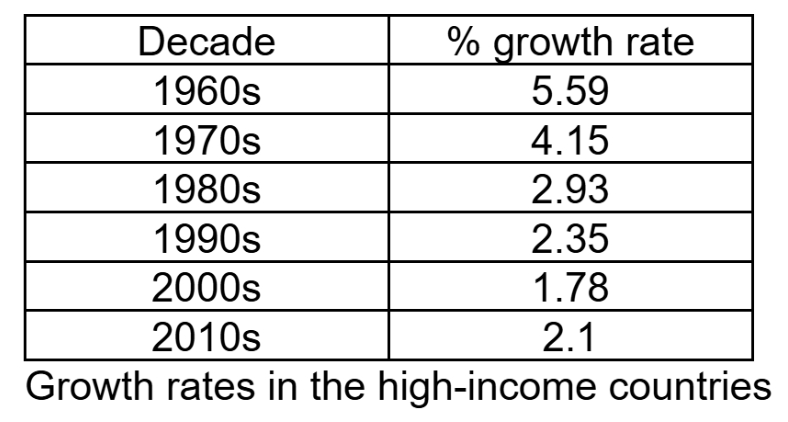
The fall in the rate of profit is also reflected in other statistics the capitalists provide, in particular growth rates. According to the World Bank average, GDP growth rates for high income countries have fallen in every decade since the 1960s apart from a small rise in the 2010s.
This all leads to the question: how close are we to the breakdown of the system?
The Present Road to Breakdown
Reese ends the book by attempting to list the developments which are today leading to breakdown. Among the symptoms he lists there are 4 key ones. These are:
- Debt figures and central bank interest rates;
- Automation reducing numbers of productive workers, hence reducing the surplus value and production prices tending to zero;
- Reduced profit rates tending to zero and figures for growth also tending to zero;
- The decline of fiat currency.
Considering the first point, Reese argues that the resort to debt is a consequence of falling profit rates. Credit is used to overcome the shortage of surplus value. According to estimates by the Institute for International Finance (IIF) global debt is $353tn (March 2026) equivalent to 280% global GDP.(20) When the stock market bubble implodes, interest rates will rise and large corporations will default on their debts and major banks will fail. US federal debt is now $39.3tn equivalent to 123% of GDP. In the past, countries with a debt to GDP ratio of over 90% have gone bankrupt and needed an IMF bailout. The US has no intention or ability to repay this debt and is even having difficulty financing it as buyers of new debt are demanding higher interest rates. If the US were to default this would precipitate the breakdown of the global system. The alternative to defaulting is devaluing the dollar and inflating its debt away. This in turn could lead to hyperinflation as occurred in Germany in 1923. Either event could result in massive attacks on the working class and massive class struggle. Regarding interest rates, Reese notes that the negative interest rates for government bonds which occurred in the early 2020s have never before occurred in capitalism's history nor have zero interest rates on long dated bonds. Germany in 2019, for example, issued a 30-year bond at 0% meaning that in 2049 2bn euros will be repaid at face value without any account of inflation.
The second point which Reese mentions is automation. This is relentlessly reducing the costs of production by excluding workers from the production process. Figures indicating the fall in the percentage of manufacturing workers in the workforce in US and UK are as follows:
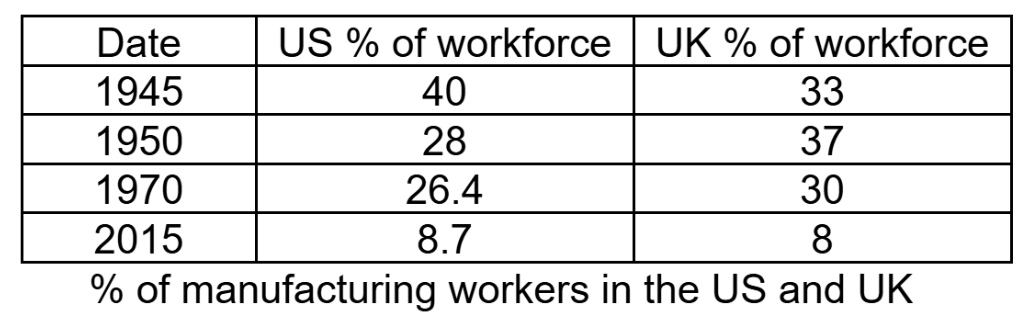
Productive workers are those producing surplus value. While the figures for other sectors of the workforce producing surplus value such as construction, mining, utilities and agricultural workers are not given, these figures are an indication of the trend of declining productive workers in the core capitalist countries. It is probably the case that the global figures are not so dramatic, but Reese argues that the trend to deindustrialisation is global. As automation reduces the percentage of workers producing surplus value, the surplus value relative to the mass of constant capital is also being decreased. Hence, the difficulty in valorising existing capital will only increase. Capitalism is digging its own grave.
The third indication of future breakdown is indicated in profit and growth rates tending towards zero. This is clearly an indication of enormous problems for the system ahead and has been discussed above.
The fourth indication Reese lists is the decline of fiat currencies. Cash is being replaced by digital currency. This is somewhat unconvincing. Digital currencies enable capitalist circulation to operate more efficiently and cheaply. This is an example of Reese's view that developments within capitalism are in some way proto-socialist relations which are growing within the womb of capitalism. In this case he thinks that digital currency could be used for a digital labour voucher system pegged to labour time which would replace money in the lower phase of communist society. While some of the developments of capitalism will be usable in communist society, it is an illusion to imagine they represent pockets of socialism maturing within the capitalist system in a similar way to those of capitalism which developed in feudal society. Before any communist measures can be introduced, including labour time vouchers, the proletariat must have achieved political power.
How can the working class achieve political power?
Consciousness and Class Struggle
As has been mentioned, Grossman was criticised by his contemporaries for putting forward a mechanical view of capitalist breakdown and minimising the issue of class struggle and revolutionary consciousness in the achievement of socialism. While it is, of course, true that the dynamics of breakdown outlined by Grossman are mechanical, the whole process takes place within a situation of class conflict. The measures to avoid breakdown, especially those combating the falling rate of profit, all entail attacks on the working class from reduction of wages and benefits, cuts and abolition of social services, undermining of universal right to education and finally unemployment. As we move towards breakdown we move to a situation in which the system can no longer satisfy the basic needs of its wage slaves and its reserve army of labour. New technologies which should make life better and ease the tedium of work lead only to speedups, unemployment and worse conditions. The social relations of production ensure that this happens. This in turn stimulates class struggle which simply makes the situation for capital worse. Grossman, who had spent his whole life in political organisations engaged in class struggle, was obviously aware of this and explained this in a letter to Mattick in the following way:
Obviously, as a dialectical Marxist, I understand that both sides of the process, the objective and subjective elements influence each other reciprocally. In the class struggle these factors fuse. One cannot ‘wait' until the ‘objective' conditions are there and only then allow the ‘subjective' factors to come into play. That would be an inadequate, mechanical view, which is alien to me. But, for the purposes of the analysis, I had to use the process of abstract isolation of individual elements in order to show the essential function of each element. Lenin often talks of the revolutionary situation which has to be objectively given, as the precondition for the active, victorious intervention of the proletariat. The purpose of my breakdown theory was not to exclude this active intervention, but rather to show when and under what circumstances such an objectively given revolutionary situation can and does arise.(21)
And in his book The Law of Accumulation Grossman wrote:
In the materialist conception of history, the social process as a whole is determined by the economic process. It is not the consciousness of; mankind that produces social revolutions, but the contradictions of material life, the collisions between the productive forces of society and its social relations.(22)
As Marx noted:
It is not the consciousness of men that determines their being, but, on the contrary, their social being which determines their consciousness.(23)
Grossman argued, and this is indisputable, that revolutionary consciousness would receive its greatest impulse from the convulsions of the period leading up to breakdown. This revolutionary consciousness will be the harbinger of communism.
CPCommunist Workers' Organisation
July 2026
Notes:
(1) Rick Kuhn is apparently a member of the heterodox Trotskyist group Socialist Alternative (Australia).
(2) Quoted T. Reese, The End of Capitalism: The Thought of Henryk Grossman, p.46
(3) Count Czernin was chief negotiator for Austria Hungary at Brest Litovsk. What this position involved is not clear.
(4) Reese, op. cit., p.89
(5) Ibid., p.89
(6) Ibid., p.85
(7) For example, the International Communist Current (ICC). However, groups that split from the ICC have abandoned Luxemburgism.
(8) David Harvey, The Enigma of Capital, p.94
(9) See: Christos Balomenos, Did Engels' editing of Capital, Volume 3 distort Marx's analysis of the ‘tendency of the rate of profit to fall'? (2024)
(10) See: thenextrecession.wordpress.com
(11) H. Grossman, The Law of Accumulation and Breakdown of the Capitalist System, Pluto Press, p.30
(12) Ibid., p.38
(13) Reese, op. cit., p.36
(14) Grossman, op. cit., p.32
(15) Reese, op. cit., p.60
(16) See: marxists.org
(17) See: E. Maito, The historical transience of capital: the downward trend in the rate of profit since XIX century (2014)
(18) Reese, op. cit., p.141
(19) A. Kliman, The Failure of Capitalist Production, p.83
(20) Reese, op. cit., p.135
(21) Grossman to Paul Mattick Sr, 21 June 1931, marxists.org
(22) Grossman, op. cit., p.52
(23) K. Marx, Preface to A Contribution to the Critique of Political Economy
Revolutionary Perspectives
Journal of the Communist Workers’ Organisation -- Why not subscribe to get the articles whilst they are still current and help the struggle for a society free from exploitation, war and misery? Joint subscriptions to Revolutionary Perspectives (3 issues) and Aurora (our agitational bulletin - 4 issues) are £15 in the UK, €24 in Europe and $30 in the rest of the World.
Start here...
- Navigating the Basics
- Platform
- For Communism
- Introduction to Our History
- CWO Social Media
- IWG Social Media
- Klasbatalo Social Media
- Italian Communist Left
- Russian Communist Left
The Internationalist Communist Tendency consists of (unsurprisingly!) not-for-profit organisations. We have no so-called “professional revolutionaries”, nor paid officials. Our sole funding comes from the subscriptions and donations of members and supporters. Anyone wishing to donate can now do so safely using the Paypal buttons below.
ICT publications are not copyrighted and we only ask that those who reproduce them acknowledge the original source (author and website leftcom.org). Purchasing any of the publications listed (see catalogue) can be done in two ways:
- By emailing us at uk@leftcom.org, us@leftcom.org or ca@leftcom.org and asking for our banking details
- By donating the cost of the publications required via Paypal using the “Donate” buttons
- By cheque made out to "Prometheus Publications" and sending it to the following address: CWO, BM CWO, London, WC1N 3XX
The CWO also offers subscriptions to Revolutionary Perspectives (3 issues) and Aurora (at least 4 issues):
- UK £15 (€18)
- Europe £20 (€24)
- World £25 (€30, $30)
Take out a supporter’s sub by adding £10 (€12) to each sum. This will give you priority mailings of Aurora and other free pamphlets as they are produced.
ICT sections
User login

This work is licensed under a Creative Commons Attribution 3.0 Unported License.