

(This is the second part of our serialisation of Onorato Damen’s book “Bordiga: Beyond the Myth”. So far we have not reproduced any of the prefaces to the successive editions since 1952 but simply produced the main texts of Damen. _
These we will return to but for now we will try to explain each part as best we can for today’s English-readers. Here (for reasons of space) we are publishing only the “Outline of the Disagreement” which prefaces the five letters. The five letters will be published on our website. _
The Outline does not make for easy reading. This is due to two factors. The first is the highly theoretical level of the debate and the second is due to the fact that after 60 years the context of the discussion is not always clear. The best example of this is in the Foreword where Damen writes _
"It is absurd to think that what one of us writes and maintains in private on these subjects should only be thought of as valid and important in this context, and this validity ends if it is revealed and submitted to the outside, collective, critique of the Party." _
What he is complaining of here is Bordiga’s campaign by personal correspondence with individuals (most notably Vercesi [Ottorino Perrone]) in the Party against the Party instead of coming to Congresses and debating the issues out in the open. _
The Outline is however revealing, to those who are willing to persist, in its explanation of the real causes of the split of 1952. _
First however we should try to explain the title “Overturning Praxis”. Damen is thinking of the transformation of one situation of accepted theory and practice (praxis) into another. In short we could equate it to revolution. And the title is the key to the debate. Bordiga wrote a series of articles in the press of the Internationalist Communist Party (under the title Sul filo di tempo) but never joined the party. He never attended a single one of its Congresses (not even the one where the split occurred) and had concluded by 1950 that capitalism had stabilised and that therefore the task of the party was to return to the task of study. Interestingly Damen does not dispute that they are living under counter-revolutionary conditions. He even thinks a third world war is likely. What he does insist though is that the proletariat has a permanent need to strive for a revolutionary party. Revolutionaries have to work to maintain its nucleus, however small, so that the whole process of revolutionary re- awakening does not have to begin from scratch once the crisis creates the conditions for the revival of the working class. The Internationalist Communist Party did not come into existence in 1943-5 just through the will of a “handful of individuals”, but because it responded to a specific crisis of capitalism and the needs of a working class ready to struggle. The party grew to several thousand by 1948, but, once the post-war boom and Marshall Plan money began to filter through, the Italian state was stabilised (with a lot of help from the Italian Communist Party of Togliatti). This led to a decline in membership and Bordiga now began to campaign for a retreat to theoretical work. Damen insists that the only meaningful theoretical work has to be made in the light of real activity within an organisation rooted in the class, hence his insistence on “praxis”. Theoretical work without roots in the real life and struggle of the class is empty and sterile, even politically dangerous. He illustrates this in the Outline by reference to some of Bordiga’s oscillations - most notably on abstentionism and on the class nature of Russia. In the first letter which follows the Outline of Disagreement, Damen took up the case of the class nature of the USSR again and Bordiga replied in the second letter. This is the debate which we will follow up next on our website.)
Five Letters and an Outline of the Disagreement
The letters which follow with their “Foreword” were published in Prometeo (No 3 April 1952) soon after the split in the Internationalist Communist Party. Onorio is the pseudonym of Onorato Damen, Alfa is Bordiga.
Foreword
"You cannot eliminate one basic assumption, one substantial part of this philosophy of Marxism (it is as if it were a block of steel) without abandoning objective truth, without falling into the arms of bourgeois- reactionary falsehood." (Lenin Marxism and Empirio- criticism - this English version taken from his Collected Works Volume XIII, 1927-8 edition, Lawrence and Wishart)
We have reached the present point of disagreement in our organisation as a result of different ways of considering, from a Marxist standpoint, some problems inherent in the present period of the capitalist crisis. The publication of these five letters, which have the merit of initiating this indispensable theoretical clarification, has thus never been more necessary, nor more opportune.
The polite polemical encounter by letter between Alfa and Onorio rather than between x and y has no special value; what is important in these circumstances is the theoretical concern which animates it, the conviction of the contending parties that they feel themselves equally faithful in interpreting the same doctrine.
What is certain however is that by publishing these writings we are not revealing any secret correspondence.
We are not attempting some speculative polemic but start from a conviction which is not only ours. This is that when a revolutionary thinks and writes to explain to himself, to interpret and understand more deeply the problems of the revolutionary struggle, it ceases to be a personal activity and becomes the common patrimony of the class to which he belongs.
It is absurd to think that what you write and argue in private on these subjects should only be thought of as valid and important in this context, and this validity ends if it is revealed and submitted to the outside, collective, critique of the Party. This is especially so when these statements and theoretical elaborations relate to problems of strategy and tactics linked to the revolutionary party’s very reason for existence, both in the present and the very near future.
From reading these letters it appears clear that the basis of dissent lies, as ever, in a different evaluation of the Marxist dialectic, a different way of adhering to its method. In reality differences of interpretation of historical materialism are as old as Marxism itself, and it seems almost as if this disagreement gains new vitality with the appearance of every new generation of revolutionaries.
Is there a danger today that our party will be uprooted from its class terrain, from its ideology and its historic tasks, through a false application of revolutionary theory? Without hesitation we reply; yes, because it is only the extent and depth of the bourgeois world crisis today which puts to the test the ideologies, the political programmes, the parties and the individual combatants. This reveals both the correct and the weak aspects of any body of ideas and any theoretical formulation in their true light. Those ideas which seemed secondary, marginal, redundant, and could be ignored and seen as a purely personal state of mind, intellectual arrogance, at the same time paradoxically inoffensive and agreeable, under the pressure of events, and their own coherence are now pushed to the surface, and clarified. They almost become a material force and are dialectically forced to show what they are, and the value of their critique.
The proletarian party either makes this theoretical contribution its own and assimilates it, or it rejects it as alien to its class nature, by refracting it through the prism of action. It continually compares any theory with past experience and the interest it can draw on, on condition that it is not just a fleeting and circumstantial idea and that it does not contradict its ultimate aims.
Overturning Praxis
Let’s examine Alfa’s schema which express his way of conceiving the dialectic.
Descending curve or branch of an ascending curve? The first formulation is unacceptable if we attribute to it a gradualism which excludes “shocks, shakes, somersaults”, the second “the branch of an ever-ascending curve” is unacceptable if to this real ascent in the world of economic things there is not also a corresponding link with the rise or increased power of the contradictions which at the same time also have a tendency “to decline”. How, then would capitalism be “moribund” for those of us who have learned that from Lenin?
"On the whole, capitalism is growing far more rapidly than before; but this growth is not only becoming more and more uneven in general, its unevenness also manifests itself, in particular, in the decay of the countries which are richest in capital (Britain)." (Imperialism, the Highest Stage of Capitalism, From Lenin Selected Works Moscow 1977 p. 728)
Bordiga’s graph expressing the “the branches of the ascending curves” does not indicate in any way the dialectical contradiction in which
"It is through its very progress that capital doubly prepares its final collapse... the economic progress of capital as it gets bigger bit by bit aggravates class antagonisms and economic and political anarchy throughout the world to the point where it provokes the revolt of the international proletariat against its dominion a long time before its economic evolution would have reached its final consequence: the absolute and exclusive power of capitalist production in the world." (Rosa Luxemburg)
It is true that imperialism hugely increases and provides the means for prolonging the life of capital but at the same time it constitutes the surest means for cutting it short. This schema of the ever-ascending curve not only does not show this but in a certain sense denies it. It is on this false interpretation of the dialectical problem that the theory of the uselessness of creating a party in a counter-revolutionary period such as the present is based. It is a theory which diminishes the party which others have already built, in its structure, its tasks and its action. It limits the function of its press to a mere theoretical catalogue which mechanically repeats the past without shedding any light on why a revolutionary vanguard, solidly anchored in the life of the problems of the proletariat, and their transformation onto the level of the historic continuity of the revolutionary struggle, is needed.
Starting from this understanding of revolutionary method we arrive at the most recent novelty... the dialectic of accepting a minimum of interest in practical action if it is justified by an adequate quantitative return. For example, the participation of the party in the electoral struggle would still be possible in spite of one’s abstentionist convictions, if the objective means for a decent quantitative result existed.
In relation to this, Alfa’s games and somersaults over abstentionist theory are significant. He insisted on the most rigid abstentionism before, and right up to, the Congress of Imola (1), in the course of which he agreed to abandon “obtorto collo” [against his will] this single well-known characteristic of the Neapolitan opposition; at Livorno he accepted elections tout court [without a quibble] until the Rome Congress; he returned to abstentionism when the political forces of the Party were in fact dispersed and with them the leadership of the Left of the Party, and today he is an abstentionist maybe yes, maybe no and for elections maybe yes, maybe no when he considers participation once again, if the certainty of numerical success could be guaranteed.
Still within the framework of this interpretation... of Marxism according to Bordiga:
"the analysis which claims that all the conditions for revolution exist but what is missing is a revolutionary leadership makes no sense. It is correct to say that the organ of leadership is indispensable but its appearance depends on the general conditions of struggle themselves, never on the genius or value of a leader or a vanguard."
This reasoning would be the fundamental argument to show the theoretical validity of his scheme relative to the overturning of praxis for which
"just as determinism excludes for the individual the possibility of will or consciousness, the necessary conditions for action, the overturning of praxis allows these to the Party alone as a result of its general historical elaboration."
In this scheme a mathematical logic prevails to the detriment of common sense, a determinism of “things” unconnected to the activity of human beings for whom it is mathematically certain that if a revolutionary leadership has defects on the political scene it is because the revolutionary conditions are not there; and viceversa, if the revolutionary conditions really exist then there will be no lack of revolutionary leadership.
Put like this the dialectic of Marx is on the same level as... the official policy of the Catholic Church which takes its evangelical creed from the preaching of Christ.
Let’s make our thinking on this more precise. The terms of the schema in question have to be “historicised” in the sense that in the determinist “prius” [i.e. what has gone before] there is not only in play individual impulses produced by economic stimuli and appetites but that these stimuli and appetites have to be understood in terms of the shifts and changes in the total process of the capitalist economy, in the level of development of the means of production, in their technical sophistication, in variations of the market, in its recurrent crises, in the growing domination of financial capital, etc., etc.
http://www.leftcom.org/files/2009-10-05-onorato-damen.jpg
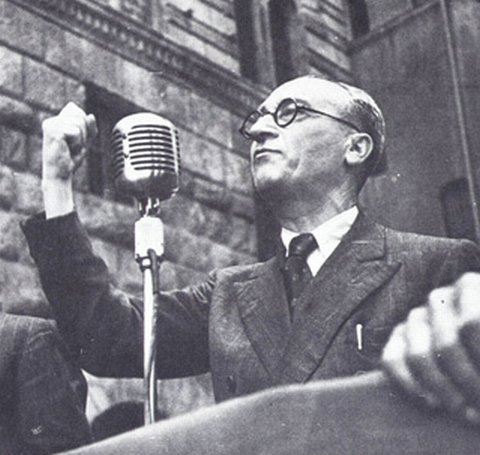
The formation and modification of human consciousness, its transformation into will and action, are reflections, at the level of social and political life, of what is produced in the sub-soil of the economy, but, between the determining factors and a world determined by the superstructure there is a relationship which in its turn reacts on the base, as an indispensable element in completing any historical event. There is no geometric schema, nor any arithmetical calculation, which can close this relationship between the world which determines and that which is determined, in some formula which is forever true and valid and which says that this impulse comes from the subsoil of the economy and that is from what is occurring in the superstructure.
In our case, an adequate and timely crystallisation of revolutionary consciousness and the will to act does not always correspond to the objective conditions offered by the capitalist crisis. The first post-war crisis (1919) in Germany and Italy tragically showed us a proletariat instinctively brought to understand the need for a struggle for power but which lacked a revolutionary leadership. The history of workers’ struggles is full of examples of favourable situations in which the proletariat missed the bus due to the presence of a Party not up to the task of leadership.
This is the focal point not only for interpreting the dialectic but also for the nature and function of the class party.
The birth of the party does not depend, and on this we agree, “on the genius or value of a leader or a vanguard” but it is the historic existence of the proletariat as a class which poses, not merely episodically in time and space, the need for the existence of its Party. The proletariat would return to the ranks of mere plebeians if it lost its class character as the antagonist of capitalism; and its possibilities as an exploited class which struggles for its own defence and liberation would be thwarted and rendered null and void if the motivation and physical forces for a revolutionary leadership were not produced from within it through its struggles.
But what, in reality, are the relations between party and class? We have to fight as foreign to Marxism the schema which rejects the existence of the Party in the period of counter-revolution and which entrusts to a restricted vanguard the melancholy task of study; which foresees the appearance of the Party in the fire of the revolutionary assault and gives to the Party, and only to it, the function of subject in the overturning of praxis. We don’t know, for how long and through what magical virtue, the body (constituted by the class) should remain without a head (the class Party).
In this schema, given the erroneous conception of the nature and function of the Party a totally catastrophic idea is precisely defined with the sudden appearance of the Party in one of the final periods of the crisis of capitalism, leaping, who knows how, from the head of Jove to resolve alone the miracle of overturning praxis. In this conception, the Party is detached from the class and its genetic development as a whole, this Party to which individual workers and the labouring class stimulate through their consciousness and will, an accumulation of the necessary revolutionary potential without which the return to the determining base would not be possible in the same way that a revolutionary outcome for a class detached from its Party would not be possible.
All this breaks the dialectical process that Marxism historically attributes to the class as the historic antithesis of the bourgeoisie: class antithesis, not Party antithesis, because the contradictions are class against class and not party against party, because, in the end, the subversive force is the class and not the Party. The Party makes revolutionary activity more perceptible and gives it real force, it renders it more conscious, and points the way towards it. In this sense the Party is a Party of the class, in the class, not outside the class and distinct from it.
The dialectical overthrow is carried out by the class as a whole, and not by the Party in place of the class: except that there will be no shift from the class in itself towards the class for itself where the nerve centre preparing and leading it (i.e. the Party) is absent.
Nothing takes place automatically independently of human action.
There exists no development of the superstructure (moral, juridical, philosophical, literary, artistic etc) which does not rest on economic development.
"But all these react upon one another and also upon the economic base." (Engels Letter of 1894 )
Thus the question of the “returning influence” of the superstructure on the economic base and on the productive forces of society is made more precise with the statement that “amongst the different series of social phenomenon there is an unending process of reciprocal action”, cause and effect substitute themselves one for the other. The “theory of reciprocal action” was made clear and summed up in masterly fashion by Engels:
"People make their history themselves, only in given surroundings which condition them and [in einem gegebenen, sie bedingenden Milieu] on the basis of actual relations already existing, among which the economic relations, however much they may be influenced by the other political and ideological ones, are still ultimately the decisive ones, forming the red thread which runs through them and alone leads to understanding." (Letter of 1894)
Where these two interpretations of historical materialism and the dialectical method diverge is inevitably the starting point for different ways of understanding the role of the party, of evaluating its immediate and long-term tasks and therefore of conceiving and carrying out its tactics and strategy.
Those who have the responsibility to lead the revolutionary party and who, when they examine problems start from an interpretation based on an mechanical economism, will, you can be sure, always remain waiting for the revolution until it is knocking on the door and warning us that the time has arrived to build the class party and proceed to the insurrection.
The theory which leads to the affirmation that there is nothing for the party to do in this period of counter- revolution is absolutely unacceptable.
It is in formal logical coherence with the view that is it useless and damaging to proceed to the formation of the party, or to keep it going, until the point where we will no longer find ourselves faced with the radical overthrow of the present relations of force between the two historic classes.
Faced with the present problems of imperialism and war the formal coherence of this arbitrary and mistaken interpretation of Marxism is also a departure from the fundamental line of class analysis and revolutionary interests if it ends up desiring the victory of bourgeois forces which carry within them the future of capitalist progress. To flirt or have flirted with forms of dictatorship just to cock a snook at democratic forms (2) pretends to ignore or forget that Lenin, with the small dispersed nuclei of the Bolshevik Party, insisted, even in the middle of the war and after the terrible collapse of the Second International, on the physical possibility of a revolutionary revival and victory.
Faced with the alternative of remaining what we have always been, or bending to an attitude of platonic and intellectualist aversion to American capitalism, and benevolent neutrality towards Russian capitalism merely because it is not yet capitalistically mature, we don’t hesitate to restate the classical position which internationalist communists take on all the protagonists in the second imperialist conflict, which is not to hope for a victory of one or other of the adversaries, but to seek a revolutionary solution to the capitalist crisis.
Faced with the alternative of saving the Party at all costs or accepting a leadership of men with ideas and methods which would force us, in the face of third world war, to repeat the political nullity, to abandon our place in the struggle and the liquidation of all organisational forms, as happened on the eve of the Second World War, we have no hesitation in reacting to this renewed deceitful attempt and in defending the party in the role which proletarian interests and revolutionary struggle have assigned to it.
This is what has led, and had to lead, to a theoretical conflict which we wanted to clarify here, even in the doctrinal domain. This is not simply a theoretical question but is at the same time a political conflict between tactics and strategies which are no longer working towards the same class objective of proletarian revolution.
(1) Held in1919. Bordiga had hoped to form a communist party adhering to the new Communist International on the basis of the Abstentionist Fraction (based largely around Bordiga’s Naples-based “Il Soviet”). The abstentionists won only a minority of the votes and the party would not be formed until the Livorno Congress of 1921 which adhered to the 21 conditions of the Communist International and thus dropped abstentionism.
(2) Although he is in the middle of arguing for the “revolutionary defeatism” inspired by Lenin, Onorato here makes an aside on Bordiga’s opposition to democratic centralism within the Internationalist Communist Party. This argument is more extensive in the previous part of the book which is on our website at http://www.leftcom.org/en/ articles/2011-01-21/amadeo-bordiga- beyond-the-myth-and-the-rhetoric-