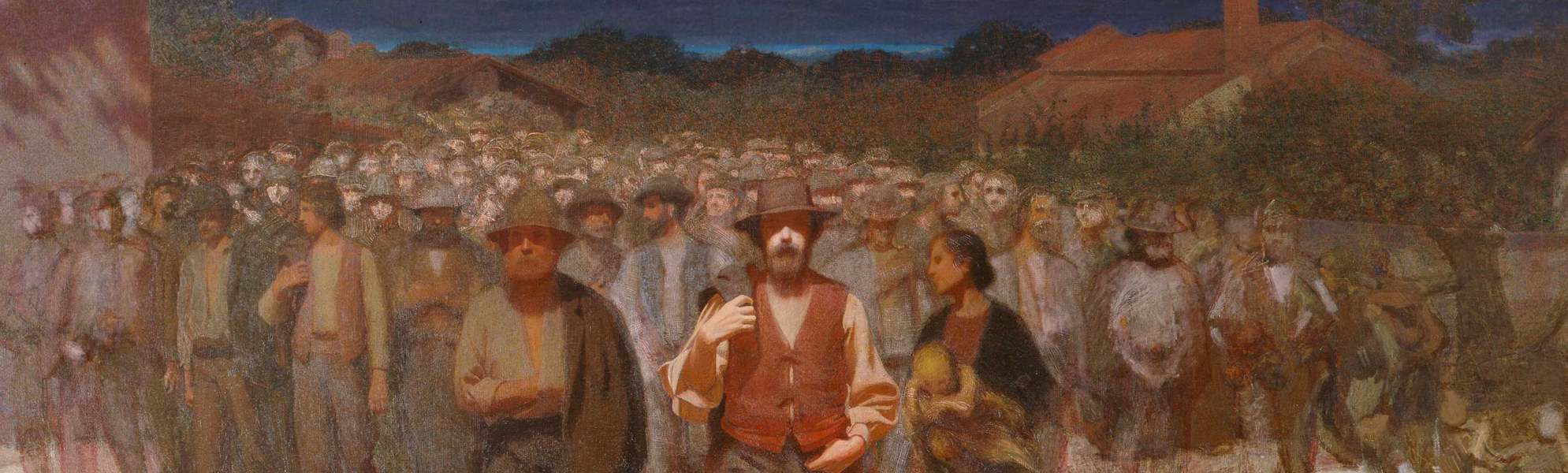

The translation which follows is the greater part of an article from Prometeo, theoretical review of the Internationalist Communist Party in 1984-5. It should be read alongside the document which appeared in RP08 on The Role and Structure of the Revolutionary Organisation (https://www.leftcom.org/en/articles/2016-08-28/the-revolutionary-party-…).
This document looks at various conceptions of the party (and not just those held in the Communist Left) but concentrates on three issues above all. The first is to explain why we reject the notion of a mass party and links it both to Social Democracy and the counter-revolutionary degeneration of the Comintern (which abandoned the model of 1917 where the Bolsheviks were formed into a cadre party of the class in the heat of the class struggle). Instead the Third International imposed social democratic notions of the party on the new communist parties which sprang up after 1917. As mass parties they were in a better position in order to act in defence of the Russian Soviet Republic rather than carry on the work of extending the world revolution.
Another central issue of the document is the need for revolutionaries at all times to work towards the formation of the party even when the social conditions for it to come into existence within the class are weak. Theorising the non-existence of revolutionaries and reducing their tasks to just theoretical elaboration breaks the dialectical link between theory and practice, between the class and its revolutionary minority. Such a view reduces the appearance of the party to the last minute and perhaps to its failure to arrive on time as happened in so many places in the post-war revolutionary wave.
Underpinning it all is the fact that the party does not come from outer space, or wherever, but comes from within the working class and its struggles, and its rise is parallel with that of the general combative consciousness of the class which no amount of voluntarism or short-term tactical shifts can accelerate.
-- CWO _
13 October 2016
The Approach to the Question of the Party
Even today it is still an issue; not, as in the past, a debate between Marxists and anarchists, or between councilists, syndicalists, and Bolsheviks; but in a more subtle almost obscure but no less dangerous way. Within the "communist left" the party question is still on the agenda.
In the dark tunnel of the counter-revolution, by which we mean not only the triumph of Stalinism in Russia, but also the distortion of the basic framework of revolutionary ideas, the role and function of the class party has also undergone much revision.
At issue is not the party as such, but its relationship with the class, the uniqueness of its political function in the class struggle, the ever open question of consciousness and its permanence in a so-called counter-revolutionary phase, and finally its tactics as a concrete expression of its political being.
Like many other issues the party notion has suffered heavy criticism from both right and left, in both mechanistic or idealistic ways, not so much as a single object of study and rethinking, but more as an appendix to a counter-revolutionary process that affected the foundations of the newly born proletarian state after Russia’s October Revolution.
Many political elements, in trying to understand a posteriori the main causes that brought about the defeat of the Russian Revolution latch on to what the Bolshevik Party did during, and especially after, the taking and management of power.
Some have seen in the lack of centrality of the party, too influenced by "external factors" such as the Soviets, especially those of non-workers, as one of the fundamental causes that favoured revisionist ideology first and counter-revolution later. Others look at the issue from the opposite point of view, seeing the inevitable preconditions for the process of degeneration in the same party structure, through its decidedly totalitarian centralism and its supposed substitutionism.
These concerns are valid even if their conclusions aren’t. In the twenties and thirties (for latecomers there are no time limits) an analysis of the route Russia was taking was an absolute priority from both the internal socio-economic aspect, as well as, from a revolutionary point of view, the role that the Soviet Republic might possibly still play on an international level.
The first great revolutionary experience, which had allowed the Russian proletariat to create the political conditions for the transition to socialism through the indispensable form of rule of its dictatorship, as the first step in an international revolutionary process, was showing signs of a gradual attrition.
Then as now, a correct interpretation of what happened was, and is, the condition for creating the conditions of a future victory of the world proletariat, even after such a severe defeat. Instead people very often fall into the error of confusing the manner and the timing of the degenerative process with the causes that brought it about.
The first big rock on which the Bolshevik revolutionary experience ran aground was its international isolation, exacerbated by a particularly backward domestic economic situation. The impossibility of creating the basis of the new society within the confines of one nation, the pressing concern to somehow solve the most basic issues of physical survival, and the opportunist aspects of the resistance to international capitalist encirclement came at the cost of increasingly giving up the demands of the revolution itself. All of which provided fertile ground for counter-revolutionary ideology and practice.
The more isolation and encirclement tightened its grip around the Bolshevik experience, the more the worm of counter-revolution was nourished in the revolutionary power structure itself, in the management of state bodies, in the relationship between the party and the class and within the Party itself.
The contradiction between a revolutionary superstructure aiming towards a socialist solution and an economic structure still based on capitalist economic categories was fatal, especially within an international framework that was moving rapidly in a totally negative direction. The second condition clearly had to prevail over the first thus halting the revolution on the threshold of the first step and preventing it from going on to the next, that of socialist construction. Especially fatal was its continuing isolation, so that the consolidation of the productive base on capitalist economic categories, even at the level of state management, would eventually erode, and finally overwhelm, the very political superstructure that emerged from the victorious revolution.
The party was also overwhelmed. Indeed, the start of the political defeat really began with it, as an inevitable reflection of an unfavourable and infinitely impossible situation both at home and abroad. Those who believe that things could have been different if only there was a different kind of party, either an even more centralised one, less influenced by “non-class” factors or, conversely, one more open to the demands of different social components, depending on their analysis and inclinations, would be taking the bull by its tail rather than by the horns. Those who simply see the key to the defeat of the Russian Revolution in the Leninist conception of the party have taken the road to political confusion and are revising one of the fundamental cornerstones of the class struggle.
It is not in the extreme idealism of a pure and uncontaminated party, nor in that of a vulgarly pragmatic party open to all sorts of tactical compromise, that the success of a revolution can be guaranteed. But these roads have been disastrously taken even within the "communist left".
Once again the poor understanding of events in Russia after the revolution, has led to confusion between the causes and the nature of the counter-revolutionary process, triggering the dangerous presumption that the solution to the most important, if not all, the evils that have plagued the international workers’ movement, can be found in a redefinition of what the party is, as well as its role and its relationship with the class in the management of power.
What is the Party?
"In the Theses on the tasks of the Communist Party in the Proletarian Revolution approved by the Second Congress of the Communist International, theses truly and deeply inspired by Marxist doctrine, the starting point is the definition of the relationship between party and class. It starts by establishing that the class party can only be a part of the class, never all, perhaps never even the majority of it."
"A party lives when it has a theory and a method of action. A party is a school of political thought and then a fighting organisation. The first is a fact of consciousness, the second is a fact of will, more precisely a tendency towards a precise goal."
We repeat these two short, concise, but extremely clear passages by Bordiga on the party issue as essential starting points, even if we do not share all of their implications, especially those he expressed later.
The question: what is the party, before it even constitutes a political-programmatic question, refers, in its content, to the relationship with the class. In other words must the party, precisely because it is the political organisation of the class struggle, the supreme guardian of the immediate but, above all, the historic interests, of the working class, contain the vast majority, or only a part, of the class? Is it possible that the party can represent the interests of the whole, or is the opposite formula true?
Coming out of the byzantine political maze, the question of the distinction between a party of cadres and a mass party was posed historically.
Almost all the communist parties that sprang up in the late teens and early twenties did so under the political inspiration of the Bolshevik experience and the Third International as revolutionary vanguards of the working class, or rather as narrower cadre parties representing the proletarian world. Apart from the purely genetic fact that the vast majority of new parties came out of the old Social-Democratic organisations of the Second International who saw themselves as mass organisations, the revolutionary "minorities" set themselves up as a kind of political opposition to the reformist "majority". The idea of a body of cadres was better suited to the dialectic of the facts than any idealistic ambitions and inclinations, and above all, fitted the only genuinely revolutionary episode: the Bolshevik Revolution.
Theory and a method of action, as preconditions of consciousness and will, can only be carried by a minority, of a part of the class. It is thus idealistic praxis to conceive of the possibility of the acquisition of total consciousness by the entirety of the class, like the gradual conquest of the "spirit".
History has shown often enough how consciousness, doctrine and method derive from the experience of the class struggle, but the class can only adhere to a political programme at certain times and under certain conditions.
The economic and political domination of the bourgeoisie is always such as to inhibit the possibilities of the growth of consciousness within the totality of the class. There are too many factors getting in the way of the development of consciousness. Lenin’s sentence that the dominant ideology is the ideology of the ruling class(1) is not just a clever-sounding abstraction, but a very effective summary of reality both then and now. For him consciousness and the programme, despite being the historical acquisition of the whole class, as the sum and synthesis of occasional and partial episodes, are a political heritage of only a part of it. Precisely for this reason the party is the most advanced and conscious part of the class that unifies its experiences, channels its efforts, and at the same time, overcomes its limitations.
The idealistic conception that claims to identify the political formation of the class as an autonomous process of acquisition of consciousness, ends up by giving the party only marginal and secondary tasks such as from time to time accelerating the class struggle or organising economic struggles. Some see it as a sort of "headquarters" of the proletarian army, denying its primary role, that of an irreplaceable political tool of the class struggle, as a synthesis of theory, method, consciousness and determination to struggle.
It is true that these factors can be identified in the class, but only partially and intermittently. They emerge in ascending phases of the struggle, but are practically non-existent or distorted in periods of complete subjugation or defeat. These elements can only be expressed in a joined-up way and have continuity over time in the party. Only within the political vanguard can all demands arising from the tumult of the class struggle be distilled and tactically and strategically ordered, very often over and above economistic spontaneity, sectionalism and corporatism.
The basic pretext, to which those old and new idealists cling in order not to retreat from their position on the question of consciousness and of self-emancipation of the proletariat, is provided by this simple syllogism: how is it possible to build a new economic and social order, the realisation of a political project based on the disappearance of classes, if the subject of this revolutionary change, the proletariat, is not conscious of its aims? Either the proletarian revolution, like the building of communism, is the result of a historical accident, as improbable as it is random, or the political consciousness for this act has to belong to the class, the whole class and not something that is outside it.
First it should be noted how the idealistic world-view obstinately considers the class and the party as two different categories that are even strangers to each other. The first is the object which the second relates to, but only as a political complement outside the class, as the bearer "from the outside" of something that does not belong to the entire class, consciousness, and so is different from it. According to this view, if first the revolution and then socialism are the products of consciousness and will, either they are the patrimony of the class or they are nothing. The moment they become attributes of the party, would lead in their eyes to some sort of process where the factor of consciousness did not exist or would be outside of the revolutionary subject.
But, in any dialectical conception, the party is a part of the class, not a more or less important appendage, or even a body external to it. They are the same class elements. The more conscious, more politically-equipped and determined make up the party cadres, alongside deserters from the other class, provided they make the revolutionary programme of the proletariat their own. It is from the heart of the class itself that its vanguard emerges. This is due to the nature of the class-party relationship, which can be seen in the very question of consciousness as a strict dialectical relationship between two forms of existence which express themselves in the same class. Otherwise you get lost in the subtle problems of one above another, one internal and the other external, in romantic Hegelian ideas about the maturation of a class ego. That's why it is only through its vanguard, or rather its party, that the class can, and is, able to express itself in a conscious and unified manner.
The class is changeable due to its economic and political subjection to the bourgeoisie. It attacks and retreats, makes gains and is defeated, and gives rise to countless demands, which are always partial and limited and often contradictory. In some historical phases of its existence it bursts with force and violence onto the social stage driven by its objective conditions, and certainly not by a definite programme.
The dialectical conception has never peddled the illusion that consciousness ripens automatically within the class and we just have to wait for a revolutionary movement. If the Bolshevik Party and Lenin had expected this to happen, not only would they have encountered a lot of difficulties, but the October Revolution would never have come about, neither in 1917 nor in the decades that followed.
The real problem has always been different. How can the spontaneity of individual sections or the vast majority of the class be connected to the programme of its political minority? In other words it is only with the presence of the party that sectional demands can become general, that the economic grievances can come out of their rudimentary form to take on political shape, that the immediate content of one struggle, of a section of the class, can be framed within a strategic vision.
The party of cadres, and its quantitative limitations, does not depend on any elite selection process, but on the actual unfolding of the class struggle, which, until the decisive revolutionary event, has to submit to the economic and political domination of the bourgeoisie. This breaks up and isolates struggles and opposes the interests of one category to another. Above all it obscures class consciousness to the point of making the historic goal ever more confused and remote.
It is utopian, as well as politically foolish to think that the class party can, in a particularly favourable situation, such as in a revolution, unify in its structure the whole class or its numerically more consistent part. This will never happen other than in the mental masturbation of idealist thought, but what will happen is that the party, in periods of direct confrontation, will have behind it, though not in it, very broad masses, in order for there to be any hope of a revolutionary outcome.
The conception of the mass party, instead of, or in opposition to, the party of cadres, began to make inroads in the political perspectives of the Third International, and consequently in the tactics of the Communist Parties at the same time as the beginning of the process of political retreat that took place in an increasingly isolated Russia after 1921. It is possible at this time to identify the same logic in the theoretical development of the mass party as that which accepted united fronts and the workers’ and peasants’ government. This was the first step in the rehabilitation of Social Democracy as part of a progressive abandonment, and not just verbally, of the dictatorship of the proletariat.
If the "tactical" goal was not the proletarian revolution for the overthrow of the bourgeois governments, but a kind of "tactical alliance" with the Social Democrats for a hybrid coalition government with the, as yet, undeclared aim of rallying around Russia those governments that were not hostile to its internal "achievements", it followed that little or no purpose would be served by having politically combative communist parties well known for holding revolutionary positions, but incapable of having any influence in fighting bourgeois institutions. Mass parties would be much better and get more rapid results in line with the new objective. They would be more flexible in tactics, more articulate and attentive to cross-class demands, or rather they would be mass parties that could make their voices heard not only in the streets but also in the traditional institutions of bourgeois power. It followed that, this greater political weight was a condition of the wider social groups that entered the party organisation. If there was no sign of an international revolution, it might as well consolidate the revolution that already existed in Russia. It counted little with the future "gravediggers" of the Revolution, that the October conquests themselves would be safeguarded and strengthened only on condition of supporting other revolutionary episodes. Either Russia had to emerge from isolation or it would collapse in on itself with no possibility of escape.
But now the new road had been mapped out and there was nothing to be done but follow it to the end, and on this road there was absolutely no place for those same cadre parties that were created by the perspective of revolution a few years before.
The transformation of cadre parties into mass parties was not a result of a different tactical approach in response to the difficulties of the time, very dangerous though they were although not irreversibly so, but to the change in strategic objective.
The possibility of building socialism in one country, once accepted, despite the demands of proletarian internationalism became the strategy which the Third International tended towards in order to create a sort of security zone around Russia. In other words, when the prospect of international revolution was declining the level of support for the needs of a "domestic socialism" increased. The less the need for revolutionary vanguards and the more the need for mass parties was invoked.
With its aims radically changed, it was also necessary to alter the way the Third International operated. It was not possible to pursue the creation of leftist governments that functioned as a political buffer for the weak Russian state structure without equipping the Third International with the right tools.
The Idealist Approach to the Party Question
It is the question of consciousness which really decides the various positions on the role and function of the party.
According to the purest idealist interpretation, consciousness being an internal phenomenon of the totality of the class, as a purely spiritual category, is an irreversible factor of self-consciousness superior to all forms of social conditioning, so there is automatically no, or a very limited, need for a party.
If it were possible for the entire class to come together as events developed, to overcome from time to time, in the course of the struggle, its internal divisions, its mere immediate demands, become more united and add increasingly advanced political perspectives to its demands but above all if it was able to develop a revolutionary programme and the tactics which flow from it, the party would not only not help, but it would become a structure whose awkward presence, in the course of the class struggle, would ultimately adversely affect, or worse, inhibit the progressive evolution of consciousness and its possible political gains.
So the only bodies that can fulfil the organisational and political tasks are those that arise spontaneously in the course of the struggle as a conscious act encapsulating both immediate tactical demands and strategic aims. The presence of a party organisation, within these institutions would distort their class nature, it would affect the political situation, above all by carrying the germs of the counter-revolution.
Councilists and anarchists of all persuasions, have made this setting a kind of dogma, not only rolling their eyes whenever they hear mention of the party, but with the "wisdom" of history, attribute to it the responsibility for the failure of the Russian revolution.
Without going to this extreme, and without taking on board in toto the method and conditions which effectively place the anarchist movements and councilists outside and against the revolutionary Marxist positions, very often the idealism, while remaining in support of the so-called party system, can be kicked out the door only to reappear at the window. An example is provided by those groups who swear by the irreplaceable necessity for the class party, but in fact they mediate the task, sidelining its function to the more theoretical and abstract rather than being operationally effective. Or as a mere bearer of ideologies, provider of armchair tactics, jealous guardian of "sacred principles", and as such incapable of taking part in the actual class struggle that, in spite of the metaphysical expectations of idealists, is always so complex, contradictory, sometimes treacherous, never linear, and certainly never pure.
History has on many occasions demonstrated that the class can spontaneously go beyond the messianic wait-and-seeism of maximalist political positions, better suited to the observation of social phenomena than in developing them into political objectives.(2)
In the first case the party is seen as the provider of slogans as generic as they are irrelevant such as “the generalisation of the struggle”, “the transformation of economic struggles into political struggles”, or invoke the need for of radicalisation without intervening in the "nitty gritty" of the struggle itself, and especially in not equipping itself with tools to link it with the class. Beyond a few slogans every political statement remains a dead letter. Such an unreal position, which deliberately remains on the sidelines of the rocky road of class struggle, is the inevitable result of the idealistic assumption that revolutionary class consciousness develops on its own anyway, choosing its own tactics and establishing its own programmatic strategies. Thus there is nothing left for the party to do other than promote these developments whilst remaining at a safe distance. There is no alternative and there is nothing more to do.
In such a framework the role of the political vanguard is debased to that of accelerator of struggles, more by definition than as a real reference point, a headquarters of the class rather than its political synthesis. The result is the inability to grow with subsequent demands of the struggle, to give themselves the appropriate tools from an operational point of view in order to establish a dialectical relationship between the spontaneity of the struggle and its political goals. In other words these conceptions of the party compel the vanguard to work at the edge of the class struggle where it's easier to be overwhelmed than to politically influence its course.
In the second case the party gives the appearance of a mummified structure sustained only by the codification of its inner workings. It survives, if it succeeds at all, by alternating this with "external" periods, based more on its internal needs than on any political life blood coming from the class struggle. If it is true that we cannot talk of a revolutionary party unless it has acquired an enormous political experience by refining and practising a method of analysis, and succeeded in establishing tactical lines in accordance with its strategic perspective, it is also true that if all this remains mere potential without expressing itself in "deeds", or postpones them to an objectively more favourable situation, then what we are faced with is a purely fictional organisation.
A first effect that hit all of those organisations that have a “wait-and-see” model of the party, as a knee-jerk reaction to a long counter-revolutionary period on the international stage, was reflected in the fact that the more they have theorised and practiced non-intervention because it is pointless, or even counter-productive given the situation, the more they have cultivated a conception of the party bordering on the metaphysical.
The more the party is estranged and isolated from the class struggle, the more its peculiar characteristics suffer the distorting effects of its self-image as omniscient. Paradoxically, just as in the first idealist theory the party ends up as an appendix, an external accessory to the evolution of the class struggle, so in the latter the party ends up becoming like a "first unmoved mover" whose main features are absolute infallibility, a mechanical and deadening centralism, and an underlying idea which denies that internal disagreements are a prefiguration of socialism.
Both idealistic approaches, both of underestimation and overestimation of the party form, before, during and after the revolution are the product of an incorrect method of approach, from half-digested lessons at the end of the Russian revolution, and the politically harsh decades of counter-revolution. The puny efforts of the vanguards that somehow resisted by swimming against the tide, in their effort to revise or safeguard the fundamental structures of revolutionary theory, have suffered, in part or in whole, under the weight of this counter-revolution.
The rest comes from isolation and the difficulties of establishing significant and lasting relationships with the class.
Very often isolation, whether voluntary or imposed by objective conditions, has accentuated both the extremes of passivity and its opposite: activism.
Although it may seem absurd and contradictory, idealism has many different faces, and different ways of expressing itself, but the method remains the same. The passive wait-and-see attitude which counts exclusively on the external situation to solve all our problems, is balanced out by blind voluntarism and wishful thinking which wants everything quickly and immediately. Both attitudes fall within the idealistic matrix, but at opposite ends.
If the party is a synthesis of doctrine and action, then the activist version puts the accent on the second. In this version idealism goes beyond the normal boundaries of activity which is appropriate to the demands of the situation, culminating in voluntarism, "whenever and wherever". By abstracting from the objective conditions, this voluntarism points to the party as the factor triggering economic and political demands. As such sees it as the "inventor" of struggles, as a subjective consciousness capable of undermining the existing social framework, regardless, or even against, the most basic laws which produce it.
Such an attitude, in addition to its lack of common sense, distorts how we interpret the dialectic between the economic situation and the class struggle, between the masses and the avant-garde, and eventually it opens the doors to opportunistic practices when expectations are regularly undermined by reality which, like it or not, is much stronger than any idealistic approach to the class struggle. The greater the external opposition, the more bone-headed activism insists on banging its head against the wall. The more organisational efforts are frustrated in a doomed attempt to revitalise struggles, the more these vanguards adopt the perspective of making political concessions in order to pursue a goal that is doomed to all round failure by the negative power of the situation.
How many times, especially in stagnant periods of the class struggle, have we seen so-called vanguards make hasty political retreats, both in tactics and by redefining "new" strategic objectives, in order to satisfy their activists by making "concrete" links with the world of work. Just as they thought they could find revolutionary solutions round every corner, they now discovered "revolutionary reforms" in new, why not, bourgeois areas for intervention, making the alleged and misunderstood "absence" of the working class a justification for all sorts of opportunistic ideological contortions.
In this sense, the bait is always ready to be taken. If the nature of the struggle and class consciousness are low, or almost non-existent, that's when voluntarist activists, rather than give up their anti-dialectical schemes, politically work at that low level of consciousness which they should, on the contrary, be trying to raise. As a last resort, they retrace their steps, but go off at a complete tangent, trying to do violence at all costs to the reality of the outside world.
Opportunism, in the economistic version tail-ends the obtuse wishful thinking of the terrorist version. They have opposite effects, but again share the same roots, seen lately(3) both in Italy and Europe with only minor differences in appearance and timing.
In conclusion, the idealistic approach, in all three versions looked at here, indifferentist, external or voluntarist, restricts or distorts the role of political vanguards, or reduces them to an appendage of the class struggle. Either it is seen as cultural factor, mythical and still outside the needs of the proletariat, or by exaggerated activism, with all its risks of opportunism, becoming in its voluntarist version, reformist.
The Mechanistic Approach to the Question of the Party
In its analysis and consequent intervention the mechanist approach always reduces the laws of the dialectic to a banal relationship between cause and effect. It removes the filter between a given economic situation and subjective human will. As the first takes shape, the latter will eventually s