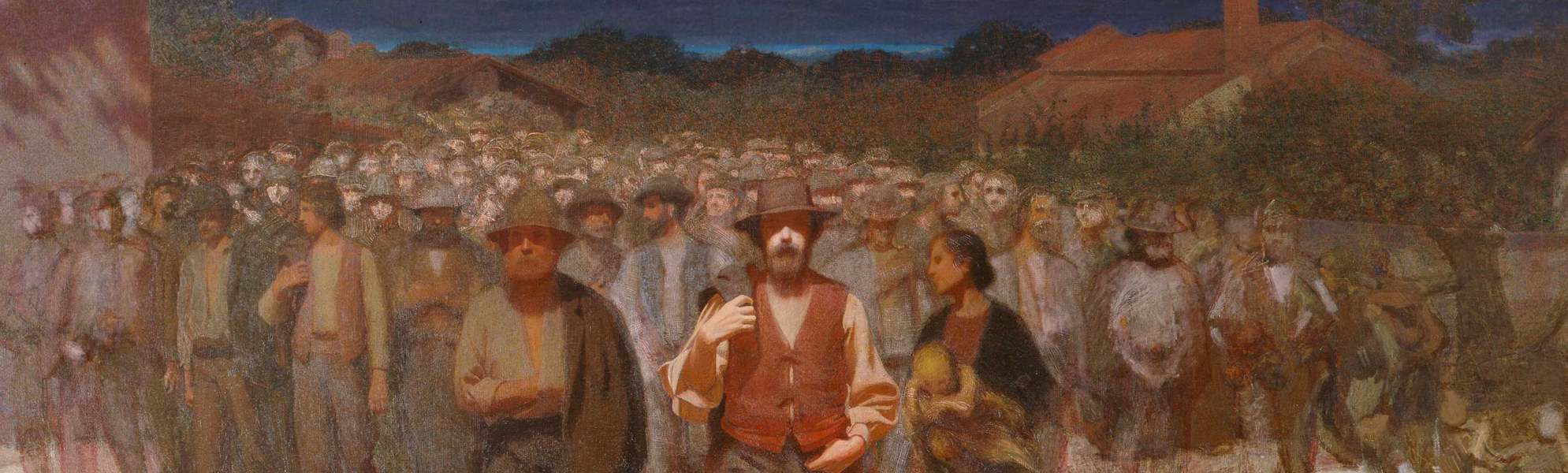

"Hegel remarks somewhere that all great world-historic facts and personages appear, so to speak, twice. He forgot to add: the first time as tragedy, the second time as farce … The tradition of all dead generations weighs like a nightmare on the brains of the living … The social revolution … cannot take its poetry from the past but only from the future. It cannot begin with itself before it has stripped away all superstition about the past. The former revolutions required recollections of past world history in order to smother their own content. The revolution … must let the dead bury their dead in order to arrive at its own content." (http://www.marxists.org/archive/marx/works/1852/18th-brumaire/ch01.htm)
Spain in Historical Context
David Graeber’s article, “Why is the world ignoring the revolutionary Kurds in Syria?”, has been widely syndicated in the anarchist and liberal press. In it he talks of the “scandal” of how the social revolution in Western Kurdistan (Rojava) is being ignored by everyone including an undefined “revolutionary left”. He chooses to start on a deliberately subjective note by announcing that his father volunteered to fight for the International Brigades in the Spanish Civil War in 1937. He goes on
"A would-be fascist coup had been temporarily halted by a worker’s uprising, spearheaded by anarchists and socialists, and in much of Spain a genuine social revolution ensued, leading to whole cities under directly democratic management, industries under worker control, and the radical empowerment of women. _
Spanish revolutionaries hoped to create a vision of a free society that the entire world might follow. Instead, world powers declared a policy of “non-intervention” and maintained a rigorous blockade on the republic, even after Hitler and Mussolini, ostensible signatories, began pouring in troops and weapons to reinforce the fascist side. The result was years of civil war that ended with the suppression of the revolution and some of a bloody century’s bloodiest massacres. _
I never thought I would, in my own lifetime, see the same thing happen again." (http://www.theguardian.com/commentisfree/2014/oct/08/why-world-ignoring…)
Our professor of anthropology(1) clearly needs to study history more carefully. The military coup of July 18 1936 against the Second Spanish Republic came after years of class struggle. The Popular Front government of socialists and liberals did not know how to respond but the workers did. When the liberal ministers refused to arm the workers they attacked the barracks of the regime and armed themselves. This unleashed a social revolution which in various parts of Spain was almost as Graeber describes it. However it did not touch the political power of the bourgeois Spanish Republic. The state was not destroyed. The leading anarchists of the CNT-FAI first decided to support the Catalan regional government of the bourgeois Luis Companys and then, only 5 months later, entered the Madrid government with liberals and Stalinists. They decided to put the fight against “fascism” before the social revolution. In so doing they abandoned any working class agenda and delivered the revolution over to the bourgeoisie. It is the most shameful episode in anarchist history and most anarchist historians will agree with that verdict.(2)
Graeber, though invoking history, turns it upon its head. For him it was the fact that Hitler and Mussolini armed Franco that led to the defeat of the revolution. Not so. It was the abandonment of the social revolution for the military needs of “anti-fascism” that was really to blame. It was the social revolution of July 1936 which had galvanised the mass of the population to begin to fight for themselves and a new society. We are not saying this would have won, given its isolation at the time, but it would have left a more inspiring legacy for us today. In fact the history of the Spanish working class was so different to the rest of Europe (the Spanish bourgeoisie did not enter the First World War, for example) that the Spanish workers found themselves fighting alone. The rest of the European working class had not recovered from the defeat of the revolutionary wave that put an end to the First World War. This defeat had already allowed fascism to be victorious in Italy and Germany.
Imperialist Manipulations
And this had also defined the imperialist context in which the Spanish Civil War came about. Graeber is also not accurate when he says that all the great powers signed up to “non-intervention”. This was the hypocritical policy of the French and British ruling classes who hoped to persuade the Axis powers to attack the USSR (thus leaving them free to pick up the pieces later). They dragged Mussolini in to it in an attempt to split the Axis, but it failed.
In the lead up to the Second World War Stalin’s USSR also had to find a way to try to win allies. It had already made “antifascism” its slogan in November 1935. And on this basis it helped to form of Popular Front governments in Spain and France. The idea was to persuade the Western democracies that they could trust the Soviet “pariah” state. As it was the USSR secretly armed the Spanish Republic from the beginning (apart from Mexico, the only state to do so). And he who pays the piper calls the tune. Although the Spanish Communist Party (PCE) had only 6,000 members in 1936 it was immediately swollen by the defection of the Socialist Party youth led by Santiago Carillo. And it grew significantly bigger by opposing the very social revolution which had started the resistance. The petty bourgeois in Republican Spain flocked to them for defence against the anarchists. And soon Communist ministers appeared in Madrid and the security apparatus (the SIM) was taken over by the PCE. Stalinist stooges like Palmiro Togliatti (“Comrade Ercoli”) and Ernö Gerö were sent to Spain to conduct witchhunts of real revolutionaries. These mainly took place after the debacle of May 1937 in Barcelona where fighting broke out between the CNT and the POUM on one side and the Stalinists on the other. It ended with a truce but with the Stalinists in the driving seat (as the “anti-fascist struggle" was paramount) and more massacres of their opponents on the Republican side. At every stage the Stalinists justified their takeover of the state apparatus by the need to make “the fight against fascism” more effective. All it did was demoralise and destroy the initiative of the masses and pave the way for Franco’s final victory and yet further massacres. Graeber is right that the revolution was suppressed, not by Franco but by the “anti-fascists” he now seeks to emulate.
This is what so many on the left from the Graeber-type anarchos to the traditional Marxist left of Trotskyists and Stalinists cannot fathom. Anti-fascism was the ideology of one side of the 1930s imperialist equation to mobilise the population for imperialist war. It worked. Graeber’s father was not the only one to volunteer for the International Brigades. So did my steelworker Dad in 1938. He was then a 16 year old butcher’s delivery boy and had no strong political views. He was (thankfully!) turned down on grounds of his age but his reaction was precisely what the Allied bloc in the Second World War were counting on to mobilise the working class for yet another slaughter after the “war to end all wars” had ended in 1918. No-one would fight for “King and Country” anymore but plenty thought it worthwhile to risk their lives fighting the evil in fascism.
And once again history partially repeats itself, the tragedy first, the farce to follow. The Graebers, as well as the Stalinists and Trotskyists are dressing themselves upon in the clothes of the past to call for support for the Kurdish nationalists against the “fascist” or “crypto-fascist” Da’esh or IS in Rojava. Now the Da’esh are a monstrous reactionary force perpetrating acts worthy of Genghiz Khan and the Mongols but fighting for or against them is not for an autonomous working class. We should be aware of the imperialist context of what is going on in Syria, Turkey and Iraq before urging anyone to go running off to fight for the PYD.(3) The PYD is dominated by the PKK although for diplomatic reasons it says it is not (the PKK is condemned internationally as “terrorist” whilst the PYD is not). The “democratic” or “mutualist” turn of the PKK is largely to try to win support in the West just as “anti-fascism” and the “Popular Front” functioned for Soviet imperialism in the 1930s.
The Da’esh are a creation of the very imperialist coalition that now bombs it.(4) Without the US-led dismemberment of the Iraqi state after 2003 there would be no space for the IS to work in. Without the initial arms supply of the Sunni regimes in Saudi Arabia and Qatar the IS would be nothing. And the Kurdish regime in Northern Iraq has been the biggest beneficiary of US policy. Barzani’s Kurdish Democratic Party regime there is a close ally of both the US and Turkey and is exporting its oil to Turkey via a new pipeline recently completed. The IS, having gained its own sources of cash, has broken free of its original imperialist masters and is pursuing its own agenda. Again there are parallels with the 1930s but not the ones our anti-fascists like to think about. In 1939 Stalin abandoned “antifascism” to sign the Hitler-Stalin Pact(5) with the very fascists the workers in Spain had supposedly died fighting. Then as now, imperialist imperatives can dictate what the name of the cause is. Whatever Graeber et al. assert, the fight in Syria today is a fight for imperialist control of the territory.
Rojava’s “Social Experiment”
And what is going on in Rojava is not as wonderful as Graeber says. He is merely relaying the propaganda of the PYD. In fact you get the impression (given the relative weight of words devoted to it) that he is more impressed by the “conversion” of the Stalinist Ocalan to the ideas of “libertarian municipalism” of the late Murray Bookchin, an ideology close to Graeber’s heart.
"The PKK has declared that it no longer even seeks to create a Kurdish state. Instead, inspired in part by the vision of social ecologist and anarchist Murray Bookchin, it has adopted the vision of “libertarian municipalism”, calling for Kurds to create free, self-governing communities, based on principles of direct democracy, that would then come together across national borders – that it is hoped would over time become increasingly meaningless. In this way, they proposed, the Kurdish struggle could become a model for a worldwide movement towards genuine democracy, co-operative economy, and the gradual dissolution of the bureaucratic nation-state."
Oh that this were true! The PKK have reviewed their strategy, withdrawn their fighters over the Turkish border into Iraq and toned down the Stalinism in an attempt to present themselves as “democratic”. But even Graeber recognises that some “authoritarian elements” remain although he does not elaborate. Let’s help him out. According to the PYD themselves there is a form of dual power with the now famous self-governing communities existing alongside a parliamentary type set-up entirely controlled by the PYD. No surprises for guessing who has the real clout. The PYD have got a virtual monopoly of weapons.(6) They are the state. And in each country (Iraq, Iran and Syria) the local Kurdish bourgeoisie has set up its own national entity in the same vein. These might not be recognised by international imperialism but they are states in all but name. In some ways they impinge more on people’s lives than the state in the UK. For example, if you are over 18 you are subject to conscription.(7) And as for the supposed internationalism of the PYD, its leader Salih Muslim has threatened to expel all Arabs from “Kurdish” territory in Syria despite the fact that most of them were born there.(8) Women may be freer in Kurdistan in general than in the surrounding territories but it’s all relative. There have been many accusations of a rapist/sexist culture in the peshmerga and Ocalan himself seems not only to condone it but to admit to it personally. None of this is discussed in Graeber’s all too brief account of the wonders of Rojava.
The one word missing from Graeber’s account is class. For him Rojava is a “people’s movement” just as the Occupy movement was. The Second World War was on the Allied side touted as a “People’s War”. But “the people” are the nation. The rallying cry of the capitalist class was that they were the representatives of “the people” against the feudal order. But we recognise that the people is an all-class idea. It includes exploiters and exploited. This is why we pose the question of class in opposition to all ideas of the people or “the nation”. Nationalism is the enemy of a working class which owns no private property nor exploits anyone. As Marx put it “Workers have no country”. The class war is not a “people’s war”.
We do recognise that there is a need for many workers to look for inspiring examples of social organisation. This is why we look to the Paris Commune of 1871 or Russia in 1905. It’s also why we look to Spain in the summer of 1936 or Russia in the winter of 1917-18. Neither were perfect but both gave some indication of what the working class was capable of doing. Both were ultimately drowned by imperialist intervention. But they were a lot further down the road to real proletarian autonomy than what is being sold to us today in Rojava or anywhere else in Kurdistan. We are used to the capitalist Left (Trotskyists, Stalinists, Maoists) rushing to support this or that “lesser evil” or lauding this or that model as “really existing socialism” (Venezuela, Bolivia, Cuba, Vietnam etc., etc.) but all they are inviting us to do is enter into the imperialist propaganda games of our rulers. A real social revolution cannot take place inside one country as the history of the 1920s and 1930s shows. If we want to see an autonomous class movement capable of creating a society without classes, exploitation, without states and murderous wars we have to fight for it where we live and work. In the long run we have to create our own class wide organisations such as workplace committees, councils or collectives or whatever is appropriate to the struggle, but we also have to make this part of a conscious fight against capitalism in all its forms. This means that the creation of an international and internationalist political movement, opposed to all national projects today, is an indispensable part of that struggle. This has to be capable of inspiring and uniting the revolutionary consciousness of wider swathes of workers. It’s not as easy or instantly gratifying as sloganising about this or that supposed workers paradise but it is the only road for the emancipation of humanity. It is that struggle which we in the Internationalist Communist Tendency are dedicated to.
Jock
(1) For a review of Graeber’s work on debt see http://www.leftcom.org/en/articles/2012-06-15/moralism-is-no-substitute…
(2) For an extended version of this analysis see our pamphlet Spain 1934-9: From Working Class Struggle to Imperialist War. It is £3 (post included) from BM CWO WC1N 3XX. Some of the articles in it can be found on our website.
(3) PYD stand for Democratic Union Party which is the Syrian franchise of the Turkish PKK (Kurdish Workers’ Party). Its military wing is the YPG or Peoples Protection Units. For more on this see the accompanying article on our website Revolutionary Defeatism Today: The Bloodbath in Syria
(4) For an explanation of the imperialist activity in the area see http://www.leftcom.org/en/articles/2014-10-15/iraq-the-new-caliphate-is…
(5) For an expansion of this see http://www.leftcom.org/en/articles/2014-09-17/75-years-since-the-soviet…
(6) Even the most pro-PKK/PYD accounts reveal that “The opposition wants to establish their own army, but they are not allowed to by the PYD.” http://www.anarkismo.net/article/27301
(7) See http://aranews.net/2014/07/conscription-law-pyd-calls-syria-kurds-defen…
(8) See Kurdish News Weekly Briefing, 3 – 29 November 2013:
"The leader of the Democratic Union Party (PYD), Salih Muslim, has warned that the Kurds’ future war would be with Arabs who have settled in the Kurdish areas with the help of the Syrian regime. “One day those Arabs who have been brought to the Kurdish areas will have to be expelled,” said Muslim in an interview with Serek TV. The PYD leader said that the situation in Qamishli and Hasakah is particularly explosive and that “if it continues the same way, there will be war between Kurds and Arabs.” Qamishli is the largest Kurdish city in Syria and Hasakah boasts most of the country’s oil wealth. Muslim’s own armed forces known as People’s Protection Units (YPG) have been in control of Syria’s Kurdish areas for the past year and a half." (from a pro-PKK site: http://peaceinkurdistancampaign.com/2013/11/29/kurdish-news-weekly-brie…)