

(From Prometeo 1 Series VII, July 2009 - In our last issue we published an article from Prometeo, the theoretical journal of Battaglia Comunista (PCInt) on the cost of the crisis so far for to the working class. Here we present a second article from that issue on the same theme of the economic crisis, this time on the prospective for the capitalist crisis whose underlying cause is not financial speculation but the permanent problem for capitalism of the declining rate of profit.)
Capitalist relations of production are based on a fundamental law - the creation of surplus value through the realisation of profit. The unequal relationship between capital and labour goes beyond capital simply making a profit but involves the extortion of the maximum profit possible. In this context the maximisation of profit is only achievable through extended reproduction based on increasing the exploitation of labour power and thereby increasing the rate of surplus value. The process of accumulation, the concentration of the means of production and the centralisation of capital all flow from this as a natural consequence.
In the early period of capitalist development the objective of extorting the maximum profit was achieved by lengthening the working day as far as was humanly possible. Absolute surplus value was the main source for the maximisation of profit. The working day reached 16 hours in Britain and other major industrialised countries. In this type of accumulation the composition of capital did not significantly change, leading not only to an increase in the mass of profits but also in the rate of profit.
But the finite limits of the working day which, even if taken to extremes cannot go beyond 24 a day, forced capitalists - aiming as always to maximise profit - down the road of reducing the necessary labour time through the everincreasing use of relative surplus value.
This allowed capital to further increase the social productivity of labour, the rate of exploitation and the mass of profit.
However, as technologically advanced machinery replaced labour power the organic composition of capital rose, thus setting in motion the conditions for a fall in the rate of profit. The increase in dead capital in relation to living, or constant to variable capital - in other words a greater increase in capital tied up in machinery and raw materials compared with the number of workers involved in production - leads to an increase in the extraction of surplus value and a huge growth in the mass of profits, but also to a reduction in the rate of profit.
If the rate of profit is the relationship between realised surplus value and the mass of total capital employed, the more the number of workers is reduced in relation to constant capital the more the basis for extracting surplus value is reduced. More precisely, the mass of total capital invested per unit of productive labour increases as does the surplus value produced by any individual workers in the process of accumulation.
The mass of profit increases but the rate of profit declines on the basis of the increase in the organic composition of capital. As is well-known, the formula s/C represents the rate of profit where s is the quantity of surplus value extorted.
This is calculated by multiplying the surplus value created by a single worker by the number of labourers employed.
C is the total social capital, i.e. the sum of constant and variable capital. It follows from this that increasing the latter in relation to the former, i.e. reducing the number of labourers in relation to the increase in capital employed, creates the conditions for a fall in the rate. In mathematical terms, if the numerator diminishes in relation to the denominator, the numerical result is lower. The relationship between s and C is the expression of the organic composition of capital whose increase provokes the fall in the rate of profit.
The organic composition of capital is calculated by comparing constant capital with variable and by expressing the figure for their reciprocal relationship in percentages of the total capital. For example, if the quantitative relationship between constant and variable capital was 80/20 the organic composition would be 400%. If we increase the first figure (constant capital) and lower the second (variable capital) to 90/10 the organic composition would rise to 900%.
The more the organic composition rises, the more it brings into play the law of the tendency for the average rate of profit to fall. Apart from short periods, capitalism cannot escape from this law which is immanent to its relations of production.
Its operation is shown in the specifics of its fundamental contradictions, a course which leads to capitalism’s decline as a mode of production and which brings with it a series of devastating economic and social consequences.
The more the rate of profit declines the harder it is for capital to find ways to express its valorisation. The more the process of valorisation slows, the more the rate of increase of socially produced wealth proportionally decreases. This is despite the enormous increase in productivity and in the exploitation of the labour force. Thus it is really the increase in the social productivity of labour, the growth in exploitation the relative surplus value which is at the root of the law. As Marx says in the Third Volume of Capital (at the beginning of Chapter 13):
“The progressive tendency of the general rate of profit to fall is, therefore, just an expression peculiar to the capitalist mode of production of the progressive development of the social productivity of labour. This does not mean to say that the rate of profit may not fall temporarily for other reasons. But proceeding from the nature of the capitalist mode of production, it is thereby proved to be a logical necessity that in its development the general average rate of surplus-value must express itself in a falling general rate of profit.”
As evidence for this we can see that the rate of growth of world production has been progressively declining due to the high organic composition of capital in the economy. In the decade 1970-80 the rate of increase of international productive capacity was 5.51%. In the following decade of 1980-90 it declined to 2.27%.
In the decade 1990-2000 it reached a miserable 1.09%. The subprime crisis then did the rest, imposing a recession on world production which declined substantially below zero. If we consider the growth of world production per capita for the same period the figures are even worse. From 3.76% in the decade 1970-80, it went to 0.69% in the next decade, finishing up at 0.19% in the decade 1990-2000. The decline in the increase in world production isn’t due to the fact that needs have been satisfied better or that demand for goods and services have autonomously contracted. This decline is due to the difficulty of valorising capital which, discouraged by decreasing profit margins, is invested less and less in real production as it responds to the siren call of speculation. In the same period, albeit with differences from one area to another, plant utilisation never went above 76% whilst speculation attracted more and more capital which previously went to productive investment. Just how the two phenomenon are related can be seen in the fact that where the process of maximising profit becomes difficult capital turns to seek extra or super profits for an additional gain. This adds nothing to the quantity of goods and services produced but it allows big capitals to acquire surplus value produced elsewhere. At the same time it favours the birth of huge monopolies in the real productive sector where the monopolistic price can be used to compensate for the losses arising from the fall in the rate of profit. It also promotes huge financial holdings dedicated to speculation which continue until the bubble bursts and reduces their profits and financial gains to zero.
First there was the Enron, Cirio and Parmalat cases, then the financial crisis linked to subprime mortgages exploded and the entire capitalist system entered the most deep and devastating crisis since the 1930s. We have to add, however, that the financial bubble burst in a real economy which was already in deep crisis and this was the cause and the spring which unleashed everything.
General Electric and General Motors are two prime examples. The two biggest corporations in the world have had recourse to financialisation to deal with their profits crisis. In the space of forty years they went from profit rates of 20% to 5%, and of this 5%, 40% was the result of speculative activity. It is exactly the same on the macroeconomic level. Financialisation developed (in close parallel with the profits crisis) and persists even in periods of partial recovery. Between 1950 and 1980 alone 15% of capital was earmarked for speculation. Between 1980 and 2003 the proportion of speculative capital rose to 25% but no further. This shows three things: the first is that the increasing difficulty of capital valorisation on the part of the real economy induces financialisation of the crisis. In other words, the attempt overcome the lack of profit from production with extra profits or financial returns which supplement the rate of profit and which could be, in part, productively re-invested. The second thing it shows is that there are limits to this. Surplus value and its related amount of profit are formed in the process of production whilst mere financial gain, the recourse to the stock market and speculation, is nothing but a mechanism for transferring surplus value that has already been created. The third thing - which is a synthesis of the first two - is that financialisation of the crisis via speculation, the creation of fictitious capital and parasitism, has an objective limit which cannot be overcome without destroying the very fictitious capital which contributed to its creation. Recently, since the end of the 1990s, stock market crises have followed one another at an extraordinary rate.
Following the bursting of the Russian and Asian speculative bubbles, the US Stock Exchange has produced the greatest destruction of fictitious capital in capitalism’s history, even surpassing that of 1929. Between January 2000 and October 2002 the Dow Jones fell from 11722 to 7286 points, amounting to a 38% loss in its share capital. The NASDAQ, or stock market for high tech firms, fell 80%. Over the same period (March 2000 to the third quarter of 2002) the consequence of the two stock market explosions amounted to a net loss of $8,400 billion. The present crisis has done the rest. Not only has it made major US financial institutions go to the wall, it has forced state intervention to avoid a global failure of the whole credit system and the real economy itself. In the final analysis these speculative bubbles are created by the financialisation of the crisis as capital increasingly turns to increasing its financial revenue and searching for extra profit in order to revive continuously declining profit rates and solve the economic crisis. Its inevitable end only poses the same crisis situation again but at a higher and more critical level. It never escapes from the vicious circle which is typical of capitalism in all stages of its existence but which in its period of decay is devastating. The most obvious example is today, where the economic and financial world face an unprecedented crisis which makes the crises of the early 2000s and even that of the 1930s look pale by comparison.
A low rate of profit not only slows the process of valorisation down, it also makes it difficult for new capital to be created. A capital of high organic composition, with its reduced rate of profit, is forced to accumulate more rapidly. The increased velocity of accumulation produces a growing mass of profit but at the same time lowers the rate of profit and the rate of its valorisation. Exactly the same dynamic explains how in periods of accentuated crisis, distinguished by greater intensity of overproduction of capital unable to find adequate profit margins, capital seeks a variety of ways out, such as economic concentration, financial centralisation and speculation. As Marx said when referring to the contradictions inherent in the law at the beginning of Chapter 15 of Capital Volume Three,
“On the other hand, the rate of self-expansion of the total capital, or the rate of profit, being the goad of capitalist production (just as self-expansion of capital is its only purpose), its fall checks the formation of new independent capitals and thus appears as a threat to the development of the capitalist production process. It breeds overproduction, speculation, crises, and surpluscapital alongside surplus-population.”
And the evidence for this can be seen in the increasingly central role of finance capital, the stock exchange, banks, investment funds and financial holdings.
Never in the history of the fall in the average rate of profit has financial capital assumed such a dominant role within capitalist productive relations. And never before has the struggle between major international currencies for supremacy in the money markets, that instrument for re-appropriating capital, been so violent.
Another effect of the profits crisis is sharpened competition for trade, both domestically and internationally. The more the mechanism for accumulation and valorisation of capital lacks oxygen the harsher the competition between capitals. The race for greater labour productivity, intensified exploitation through the increase in relative surplus value, exacerbates the competition between capitals - a competition which is in turn the product of the profits crisis - and produces, as its first consequence, a historic attack on the living and working conditions as well as the wages of the working class.
Chronologically the evidence is stark. If we compare the times of these attacks with the steepest fall in profits it shows that the economic and social dynamic is the restriction of on profit margins. It all started in the mid 1970s when the rate of profit touched its historic low level of less than 53%. The attack took place on several fronts. In terms of direct and indirect wages it has taken the form of containing labour costs and dismantling the welfare state. Over the last few years wage levels have returned to those of the 70s in every major capitalist country. At the same time social security provision has been reduced.
Increasingly the relationship between capital and wage labour is one involving more flexibility and job insecurity to an extent unequalled in recent history. The profits crisis means that, in addition to reducing labour costs, the capitalists also have to ensure that the labour force is only employed when the valorisation of capital demands it and then that workers are automatically laid off when no longer needed. Capital cannot allow itself the luxury of maintaining a workforce which it is not able to exploit at a rate compatible with its own valorisation needs. Neo-liberalism and globalisation are the real offspring of the profits crisis.
Once extolled by leading bourgeois economists for their extraordinary advantages, they are now being discarded as noxious to the healthy development of capitalism in favour of state intervention.
Yet the severe limits to the process of valorisation within the various national capitals has imposed on big capital the need to overcome all possible barriers to the circulation of capital, commodities and the procurement of strategic primary products and labour power at the lowest possible price. The export of finance capital, the delocalisation of production, the intensive exploitation of the workforce at very low cost, these are all the inevitable corollaries of the slow pace of valorisation typical of the advanced capitalist countries with a high organic composition of capital. If all these objectives are realisable on the level of “normal” imperialist competition, fine, otherwise the force factor intervenes to resolve things. War has become the daily means by which imperialism seeks to obtain desperately needed economic and financial advantages. Is there anything new under the capitalist sun here? Certainly not, but in the present phase of capitalism, warmongering, like any other form of imperialist behaviour, is directly proportional to the gravity of the economic crisis. The tendency for the rate of profit to fall doesn’t create new contradictions or unusual forms of behaviour on the world market, but its does make them worse, pushing them to extremes as serious and desperate as the crisis which produced them.
From the fall of the Soviet Empire to today, whilst the Western bourgeoisie have been crowing about its victory and announcing a new period of peace and prosperity, the abyss of international crises and imperialist war has opened up with an intensity and violence not seen in recent years. In all areas - from economic to political factors, both in domestic and international terms, in the relationship between capital and labour and in the resort to arms - the situation has got worse. Thus interbourgeois tensions have multiplied and intensified in an orgy of decadence where increased exploitation of the proletariat, increased poverty in general, are the only constants in a capitalism trying to put together the conditions for its own survival.
The Decline of the Average Rate of Profit in Figures
In bourgeois literature it is difficult to find clear data on the fall in the average rate of profit. The explanation is obvious. No bourgeois economist, however aware and fearful of the law and its disastrous consequences, can openly confess to investigating the relationship between the mass of profit and the total capital employed to obtain it. Not so much because they don’t want to use Marxist economic categories, although they always reject them, but more simply because they ignore the problem when they put the mass of profit at the centre of the issue and not its rate. Even so, on the basis of the known facts, they do issue warnings about declining returns on industrial investment and the lack of valorisation of invested capital. Publicly they pretend that the explanation lies outside the relations of production, as if it were a question merely of the market or the sale of goods or, at most, of a dysfunction in the productive process and thus that a readjustment of these factors would resolve the problem. Even so, when the capitalist managers attempt to deal with the worrying consequences of the fall in the rate of profit they are forced to deal with the cause of the problem and not its economic effects, thus bringing into play a vast series of countermeasures. A marxist analysis is a lot simpler and more effective because it is stripped of any constraints or mystifications; it is based on the dynamic of the real facts centred round the antagonistic and contradictory aspects of capitalism.
In order to look at both the law of the decline in the rate of profit, and the countertendencies it provokes, we’ll look at the example of the postwar US economy. The choice is forced on us because the figures relating to profit in the US economy are the best known and best researched. According to the French Institute of National Accountability (INSEE) the average rate of profit of the US economy from 1955-2000 declined more than 30% and in the period 2002-5 it fell more than 35%. Further dissection of this statistic reveals that between 1954 and 1979 the rate of profit fell by more than 50%. In the period 1985-97 there was an extraordinary recovery of around 20%, finishing with the years 1997-2002 which saw a fall of 21% from the peak of 1997, a fall which carried on until 2007.
http://www.leftcom.org/files/2009-07-01-rate-of-profit-usa.jpg
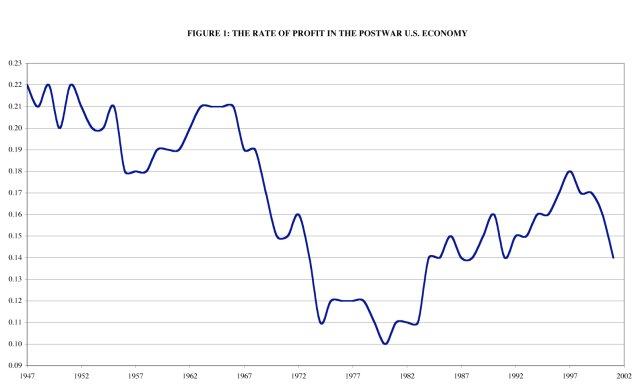
In percentage terms what has happened is that in the first period we went from an average rate of profit of 22-23% to 11-12%. In the second it went back up to 18% only to fall once again in the third to 14%. The figures tell us that, on the basis of changes in the organic composition of capital, the rate of profit has to fall in the long run. In the short term however, due to exceptional circumstances as a result of the operation of certain countertendencies, the rate of profit can grow or else its decline can be clearly slowed down.
(See Figure 1 top of p.18: The rate of profit in the post-war US economy)
The apparently contradictory aspect derives from the fact that in the first period (the golden age) when the rate went from 22% to 12%, the US economy grew enormously at a rate never reached again in succeeding decades.
The average rate of annual increase in GDP was around 5%, unemployment never rose much above the physiological minimum of around 2% and inflation never went above 2.1%. The US economy dominated world trade. It had an enormous surplus in its balance of payments and was exporting financial capital with a net surplus of 17%. The only explanation for the fall in the rate of profit is the rise in the organic composition of capital, itself driven by the extraction of relative surplus value.
In the space of thirty years the latter increased by 41%, going from 3.58% to 5.03%. These are impressive enough figures in terms of speed and intensity, though they do take place over a long period. The important point is that in the post-war period of economic expansion the need to continually reduce necessary labour time by means of relative surplus value leads to enormously more investment in constant capital than in variable. As dead capital replaces living labour, the source of extraction of surplus value is enormously narrowed, despite an increase in the rate. This explains how the American economy “suddenly” found itself - at the end of the 60s and beginning of the 70s - in its severest economic crisis since 1929- 33. This was when the leading sectors of the economy were overtaken by those of Germany and Japan. Having lost its domination of the world market, the “made in the USA” economy found itself for the first time since the Second World War with a balance of payments deficit on its current account. The USA now had to import capital from abroad as its competitive position declined due to a fall in the rate of profit which had literally halved. The revival of the rate of profit, or rather the slowing of its decline, which took place between 1985 and the end of 1997, was brought about by three factors. The first reason for the recovery is the absolute success of US pressure at the historic Plaza Summit (1985) to the detriment of Germany and Japan. On that occasion the US forced its two major trade and financial rivals to revalue their currencies, thus giving the US economy a competitive edge in commodity prices and therefore on the balance of its current account.
The second was the high interest rate policy promoted by the US Federal Reserve with the aim of recycling the enormous mass of petrodollars which had shifted from the industrialised countries towards the oil producing countries after the first, extraordinary, increases in the price of crude oil.
Taken together, these two actions ensured that the dollar would continue as the main trading currency in all the world markets (92% of all trade was in dollars) and that fresh sources of capital would flow towards the asthmatic US economy to be invested partly at home but mainly abroad. With an increasingly devalued dollar in relation to competing currencies, yet still retaining the dominant international exchange medium, the US was able to recover its competitive advantage thanks to the consequent relative lowering of the price of US goods.
(See Figure 2 below: Real Hourly Wages in the USA)
The third factor, and certainly the most important, was the reduction in labour costs. Lower taxes on firms, lower money costs and, above all, stagnation of real wages which did not increase at all throughout the entire period. Indeed wages declined thereby contributing to a recovery in the industrial and manufacturing rate of profit to 20%. In the building sector things were even better for the capitalists. Between 1978 and 1993 real wages in this sector have been reduced by 1.1% a year, allowing invested capital to obtain a rate of profit of 50%. We have also to take into account a political factor in regard to this economic data and that is the low level of class struggle which allowed capital to restore profit margins relatively easily. Where working class response to the attacks of a crisis-ridden capitalist system is weak, or even nonexistent, it becomes more practicable for the capitalists to impose the policies of the counter-tendencies with the aim of restoring significant profit margins.
These policies include the infamous calls for sacrifices which are still in force today. Originating in the USA, they have spread to the rest of the Western world with the compliance of the unions and the Left. The export of financial capital and the shift to globalised production did the rest.
Despite the consistent recovery in the rate of profit in the 1980s and 1990s the latest crisis has brought the US economy back to the same precarious situation as at the end of the period of expansion.
By 1998 a series of problems, which the artificial revival of the 1990s had concealed, came to a head. The gambit which had begun with Reaganomics in the 1980s went into crisis. It was based on the draining of world savings to the USA by means of high interest rates and the dominant role of the dollar, but it also involved abandoning some traditional sectors of the economy and a consequent reduction in competitiveness. Moreover, the crisis encompassed foreign investments, the delocalisation of production and the high tech sector on which most of the strategy was based. The increasing indebtedness of the state, of firms, of families trying to buy houses and the means of daily existence, produced a real tragedy whilst the rate of profit inexorably declined. The more profits declined the more the recourse to parasitism, and increased financialisation of the crisis. And so the speculative bubble expanded exponentially, creating the conditions for the explosion in August 2007. The worst aspect of all this is that, once again, the international proletariat is being asked to pay the price. When the speculative bubble - which swelled to provide cheap credit for companies and families as well as the entire economic system - burst, billions of dollars were wiped out in a few days in the fictitious stock market environment. This created a crisis for the whole system of finance, a crisis which revealed the limitations of the entire capitalist system, including a real economy which was already massively weakened, and which was now thrown into the abyss. The housing market collapsed like a house of cards, then all the most important productive sectors, including high tech, began to show signs of collapse. Previous investments in constant capital and software had already reduced productivity. On average, before this further fall in productivity, plants were working at around 60% of capacity. In addition the 3.5% wage rises which were possible during the later stages of the economic boom have become an unsustainable burden on a capitalism in crisis. In a short space of time indebtedness - of the State through the public debt, of businesses which made financialisation their model of development, and of those families who believed in the illusion of easy consumerism - reached new dimensions, throwing the rate of profit of the US economy into the black hole of economic crisis. As a consequence between 2000 and the beginning of 2003 employment fell by 6% and real wages by 1.6%. Productivity fell 40%, plant utilisation 30%, whilst GDP - which had increased by 4.7% in 1997 - fell to 1.3% per annum for the period 2000-3 before going down to minus 6% today.
The overall result is a colossal reduction in net profits. The mass of profit of electronics firms fell from $59.5 billion in 1997 to $12.2 billion in 2002 whilst today the balance sheet has literally folded. In the semi-conductor sector profits fell from $13.3 billion to $2.9 billion. In telecommunications from $24.2 billion in 1996 to $6.8 billion, whilst the service sector saw a drop from $76.2 billion to $33.5 billion.
Finally, in this period the fall in the rate of profit in non-financial activities was on average around 20% with a maximum of 27% compared with the 1997 peak.
All these figures have came to light with the implosion of the subprime crisis.
Returning to the graph (figure 1) and to the breakdown of the period 1945- 2003. We can see the ups and downs of the rate of profit. In the period 1947- 77 there was a decline of 53%. Between 1985-97 there was a recovery of 30% and in the final phase to 2003 it fell 30%.
Subsequently the decline continued until the crash of the last two years.
The result is that over a period of 56 years the American economy has had an average fall in the rate of profit of 30%, with all the economic consequences for capital and the daily existence of the working class. At the international level it has led to increased competition on all the strategically important markets and has produced the tragic phenomenon of war as the only “solution” for the great powers in pursuit of their economic and strategic interests.
(See Figure 3 above: Profit Rates for Germany, the USA and Japan)
The operation of the law of the fall in the rate of profit in the USA is paralleled, even if the timing is slightly different, in all the major European countries (Britain, France and Germany) and this has opened up a period characterised by six factors.
1. An economic attack on the labour force which in terms of length and intensity has no equal in the recent history of international capitalism. The intensified exploitation of labour power through increased productivity brought about by reducing the time and cost of production of commodities has not produced greater wealth or shorter hours for workers, rather it has done the opposite. In a capitalism of high organic composition and low rate of profit an increase in labour productivity implies lower wages, a longer working day, the dismantling of the welfare state and increased job insecurity, as a result of the increased rivalry between capitals pushed into the vortex of competition by the profits crisis.
2. The export of financial capital, the dispersal of production, the tireless search for labour markets where the cost of labour power is massively lower than domestic rates, all these have become a condition for the survival of capitalism in crisis. Entire areas have been taken by storm by capitals in search of a higher return from low cost labour markets. Eastern Europe has become one of those areas to which France, Germany and Italy have exported a good part of their manufacturing industry. South East Asia has provided the same function for Japan and lately also for China. The US colossus, though with feet of clay these days, has shifted to Asia and Africa in order to compete with China as well as to those areas of South America which still remain submissive to the imperialist role of Washington.
3. Recourse to financialisation through super or extra profits, a systematic recourse to speculation and parasitic activities, the creation of fictitious capital, give a sense not only of the difficulty of valorising capital but even of the decadence of the entire international capitalist system.
4. The present crisis has furthermore made it clear that we are not just dealing with a crisis of neo-liberalism but of the entire economic system which has reached the final phase of the third cycle of accumulation. The same bourgeois economists who were only yesterday expressing fears about the role of the State in the economy as the worst of all evils invoke it today as the only road to salvation. They have forgotten that it is not the form of the management of productive relations which can wipe out the system’s contradictions but, on the contrary, it is the crisis of the system which from time to time reveals the limits of whatever type of management is in operation, whether it be liberal, neo-liberal, statist or a mixture of them, depending on the previous historical course pursued by capitalism.
5. The need to do everything possible to seek out markets in primary products, above all in oil and natural gas. After the USSR collapsed we witnessed a process of imperialist re-composition which is still going on where enti