
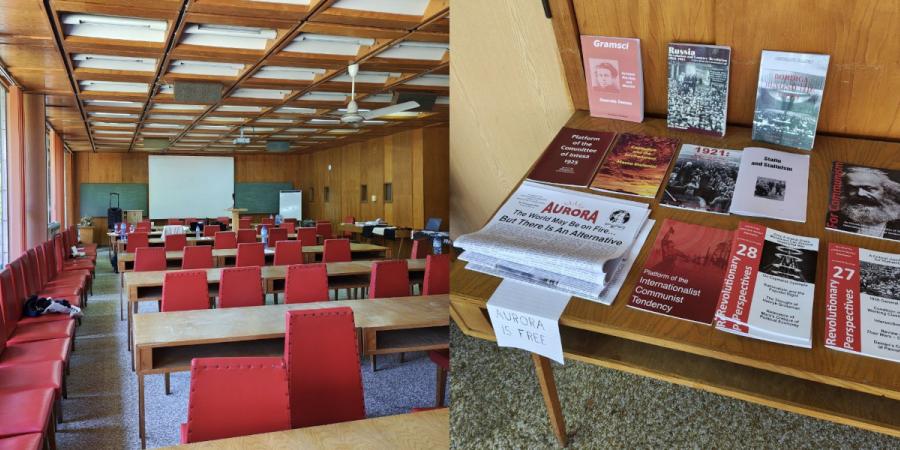
Between 18-20 September 2026, an internationalist conference was held in Varna, Bulgaria, on the subject of capitalism’s drive to war and the possibility of a working class response. It was hosted by the Konflikt group (based in Varna) and organised by an international committee. The ICT was invited to speak about our work in the No War but the Class War (NWBCW) committees, as part of a session on internationalist initiatives against war, along with the International Workers Association (IWA-AIT) and others.
As the discussions would be in English, the CWO was asked to organise a delegation on behalf of the whole ICT. Apart from us, there were 14 organisations in attendance, with delegates and individuals coming from at least 11 different European countries, and more contributions submitted as texts from organisations and individuals supporting the aim of the conference but who could not attend in person. Due to the international situation, delegations which had been hoped for from Russia, Turkey and Iran were not able to attend, and others who were planning to come chose to cancel their delegations in the face of the rising costs of international travel, particularly as a result of the US-Israel war with Iran.
Topics covered at the conference included: the issue of desertion and how to help war-resistors in countries currently involved in open conflict, the role of the working class in direct action against arms shipments, the economic background to the drive to war, the ‘national question’ and its relation to militarism. The basis of the discussions was internationalist, though of course there was disagreement among the various groups on some subjects, such as the relationship of war to economic crisis, the utility of union frameworks in organising mass resistance, and the role of revolutionary organisations in propagating an ‘anti-war’ message. There was a divide between groups who emphasised immediate ‘anti-militarism’ as a tactic, and groups with a more revolutionary perspective that emphasised the political work of organising inside the class, as we also found (to a much greater extent) at the Prague anti-war congress of 2024.
Nevertheless there was clear agreement on the nature of nationalism today, a rejection of national ‘solutions’, and no support for ‘rival’ nationalist projects against the main imperialist powers. The contributions were serious and the discussions were comradely. From the ICT’s perspective, this reinforced the idea we have been putting forward for some time that, at present, the old proletarian milieu does not exist as an independent political force. What we have currently is an internationalist camp that is much more heterogenous and composed of all kinds of groups from the internationalist wing of Anarchism, to different groups of different political origins including groups of the Communist Left. What unites them is an internationalist position, and the real split is between those who are real internationalists and for the revolutionary overthrow of capitalism by the working class, and those who see national 'solutions' to the crises of capitalism.
However, the conference did admit the group Lotta Comunista as participants. They did not make a presentation to the conference, but were in the audience, and asked questions and made some political interjections. Our delegation made representations to the organisers that we do not see Lotta Comunista as a genuinely internationalist group.
For future conferences of this kind, especially if organisers wish to expand the list of groups in attendance, we think having a clear definition of internationalism, some kind of minimum points of agreement, would be a welcome starting point.
Having said that, the conference was on the whole very well organised and in the opinion of the ICT it was a positive development to bring revolutionaries together. We were able to renew some links that had been made at the conference in Prague in 2024, as well as form new relationships with some organisations we had not met before. The emergence of new groups, often of young workers seeking to understand the place of the working class inside capitalism, was very encouraging, but so was the comradely way in which more established groups were able to discuss together. At least, we hope that we have a better understanding of each other, and more than that, we hope to be able to work together in the near future with some of these organisations, as the world situation makes it ever more important for revolutionaries to work together to bring a revolutionary perspective to the working class.
Varna was not Zimmerwald. It was not even the Stuttgart or Basel conferences of the Second International in the lead-up to the First World War. The state of the class movement, to the degree that we can even speak of one, is very different today compared to the early 20th Century. We do not expect practical resolutions to be adopted, let alone implemented, in the immediate term. Many political questions remain to be clarified. But conferences such as those in recent years in Brussels, Arezzo, Prague and indeed Varna, alongside initiatives like NWBCW, could be the start of a dialogue. And, to end on an optimistic note, one day maybe these efforts will be seen as the first small steps towards the revival of an international and internationalist reference point for the working class. But as we see it, we need a new wave of class struggle and a new generation of revolutionaries for this process to really take off and to overcome the limits and sectarianism that still plague the internationalist camp today.
This new wave of class struggle must lead to revolutionaries coming together to form a revolutionary organisation - a party for lack of a better word. This will be an indispensable tool for a successful overthrow of capitalism. This insight is still widely missing today, which hampers the development of the internationalist camp.
Internationalist Communist Tendency